*Companion article to the "GEO AUDIT" video. Author — Ievgen Kovalevskyi, building websites and advertising since 2009.*
A client asks ChatGPT who to choose. ChatGPT names your competitor. You — not mentioned.
You will never even hear about it. You just get slightly fewer leads. With no signal at all.
The good news: you can check this yourself. Right now. In two minutes, with no sign-up and no audit. Below is a step-by-step guide: one honest query, three possible answers, and how to read each of them.
---
In short
- Open your browser in incognito mode.
- Go to chatgpt.com and do not log in. You are a guest — a stranger client.
- Paste one ready-made query: your service + your city, without your company name.
- Read the answer. Named — look at what for. Only competitors named — write down who, and what for. Nobody relevant named — the AI has almost no data on your niche.
One check, one phrase. It is not the full picture. It is a quick, honest test: yes or no.
---
What you need
Just a browser and two minutes. No account needed. No paid plan needed.
The check is honest only under one condition: ChatGPT must not know who you are. That is why the first two steps are about anonymity, not about the query itself.
---
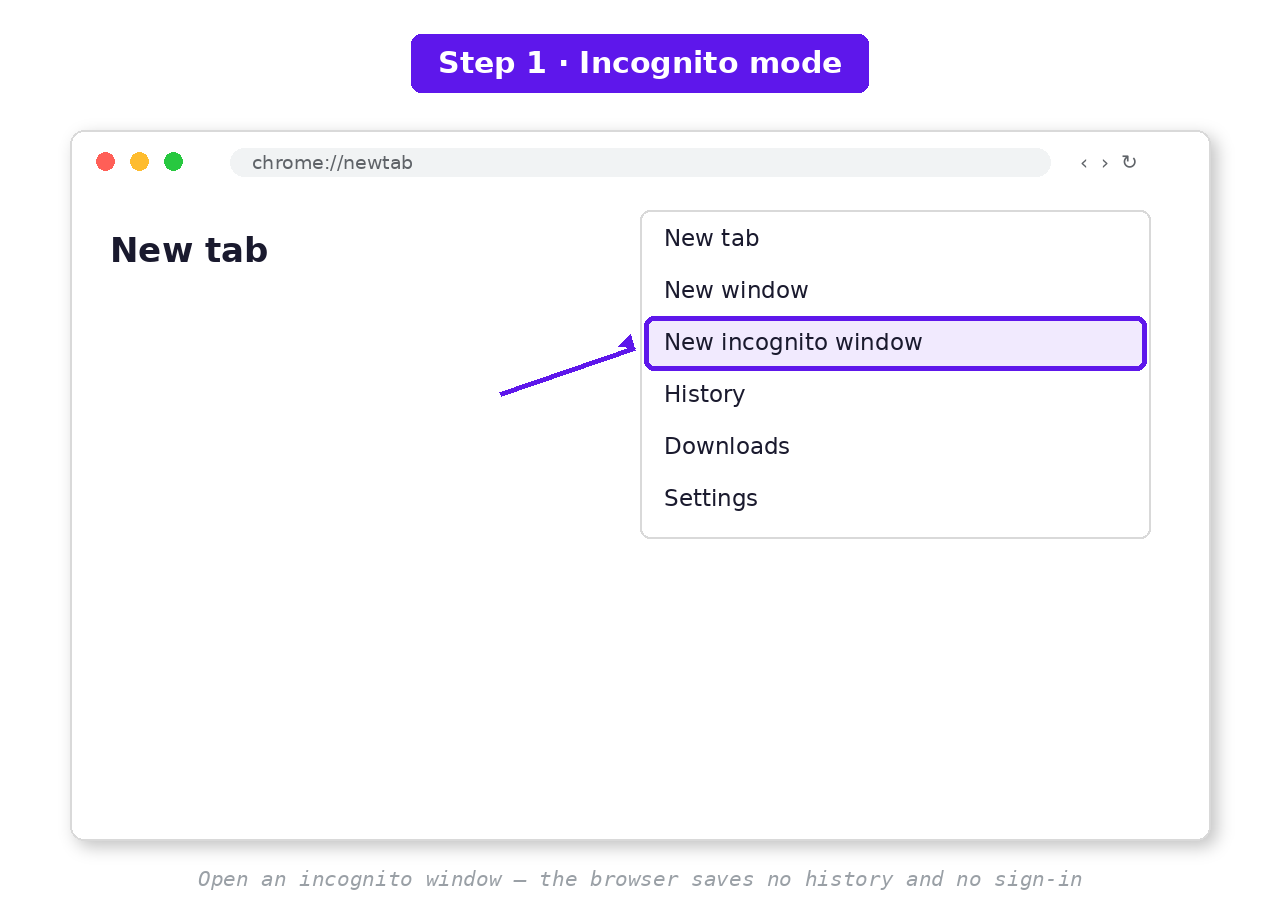
Step 1. Open your browser in incognito mode
Open your browser in incognito mode. In Chrome: "File → New incognito window", or the three-dot menu.
This matters. If you log in as yourself, ChatGPT knows you. It remembers your conversations. It may name you out of politeness — because you told it about yourself.
You need the view of a stranger. Someone searching for your service for the first time, who knows nothing about you.
---
Step 2. Open chatgpt.com as a guest
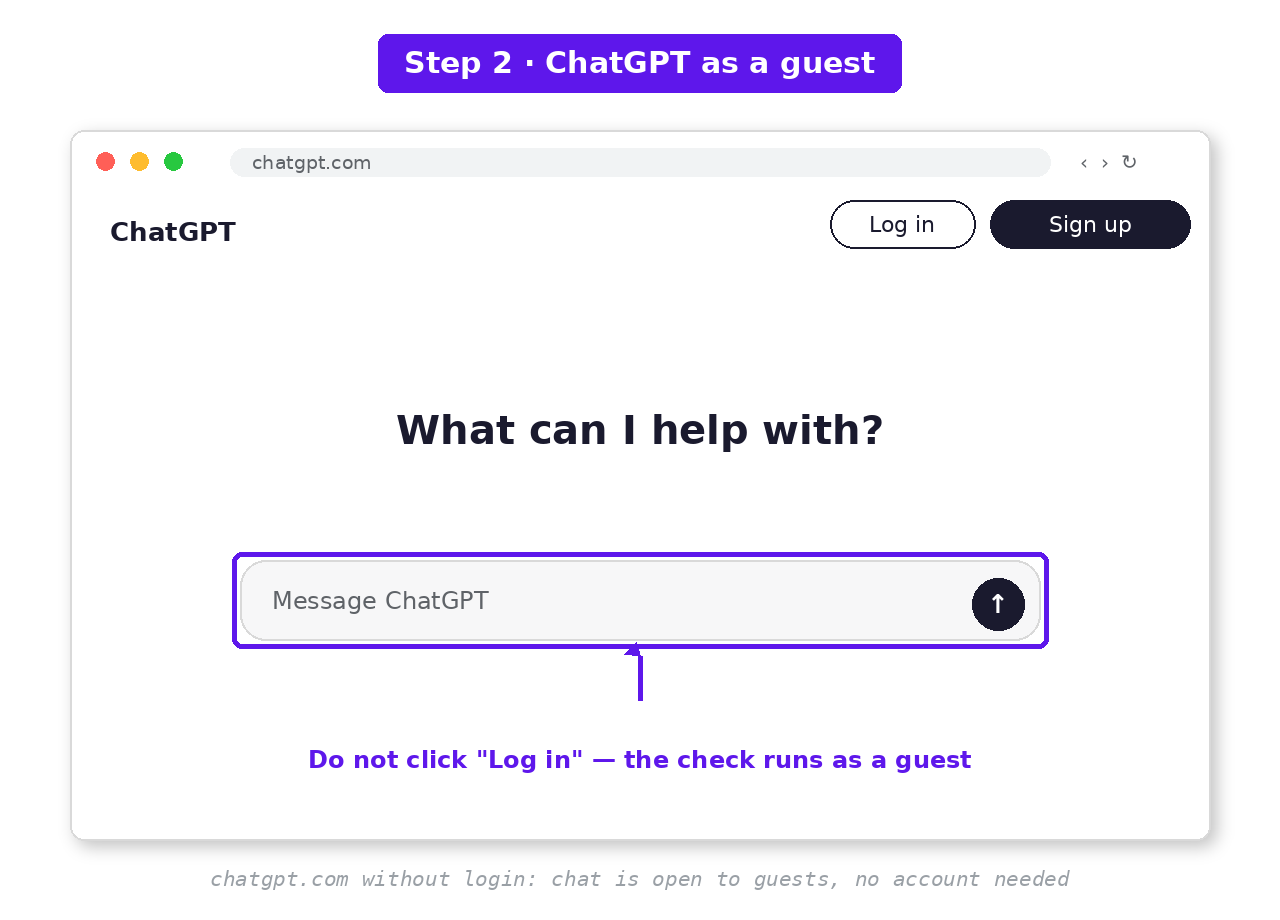
Go to chatgpt.com and do NOT log in.
Open the chat as a guest. Do not click "Log in". Do not create an account. Just open a new chat — exactly like a person who is looking for your service for the first time.
Logging in breaks the whole check. Logged in, you get the answer "for you". As a guest, you get the answer "for the market".
---
Step 3. Paste the ready-made query
Copy the query below. Insert your service and your city.
Recommend who to order [your service] from in [your city]. Name 3–5 options, explain why these ones, and give links to where you got it from
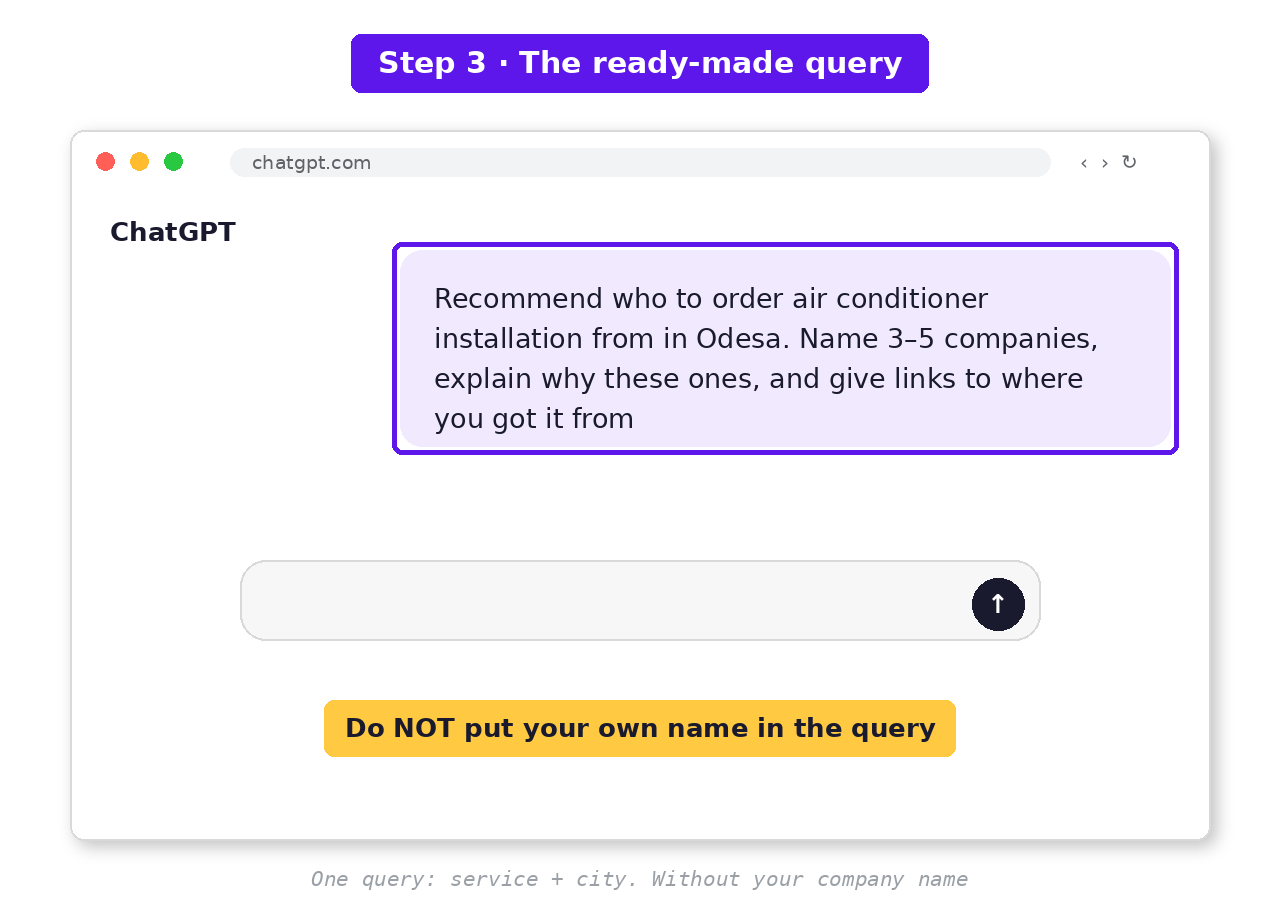
The key rule: do NOT write your own name. Not in the query, not as a hint. Write it — and the check is rigged: the AI will simply pick up your prompt.
Ready-made examples
Local service:
Recommend who to order air conditioner installation from in Odesa. Name 3–5 companies, explain why these ones, and give links to where you got it from
Expert:
Recommend a psychologist who works with anxiety, online. Name 3–5 specialists, explain why these ones, and give links to where you got it from
Business service:
Recommend who builds websites for dental clinics. Name 3–5 providers, explain why these ones, and give links to where you got it from
Send the query. Wait for the full answer. Now the main part — read it correctly.
---
How to read the result
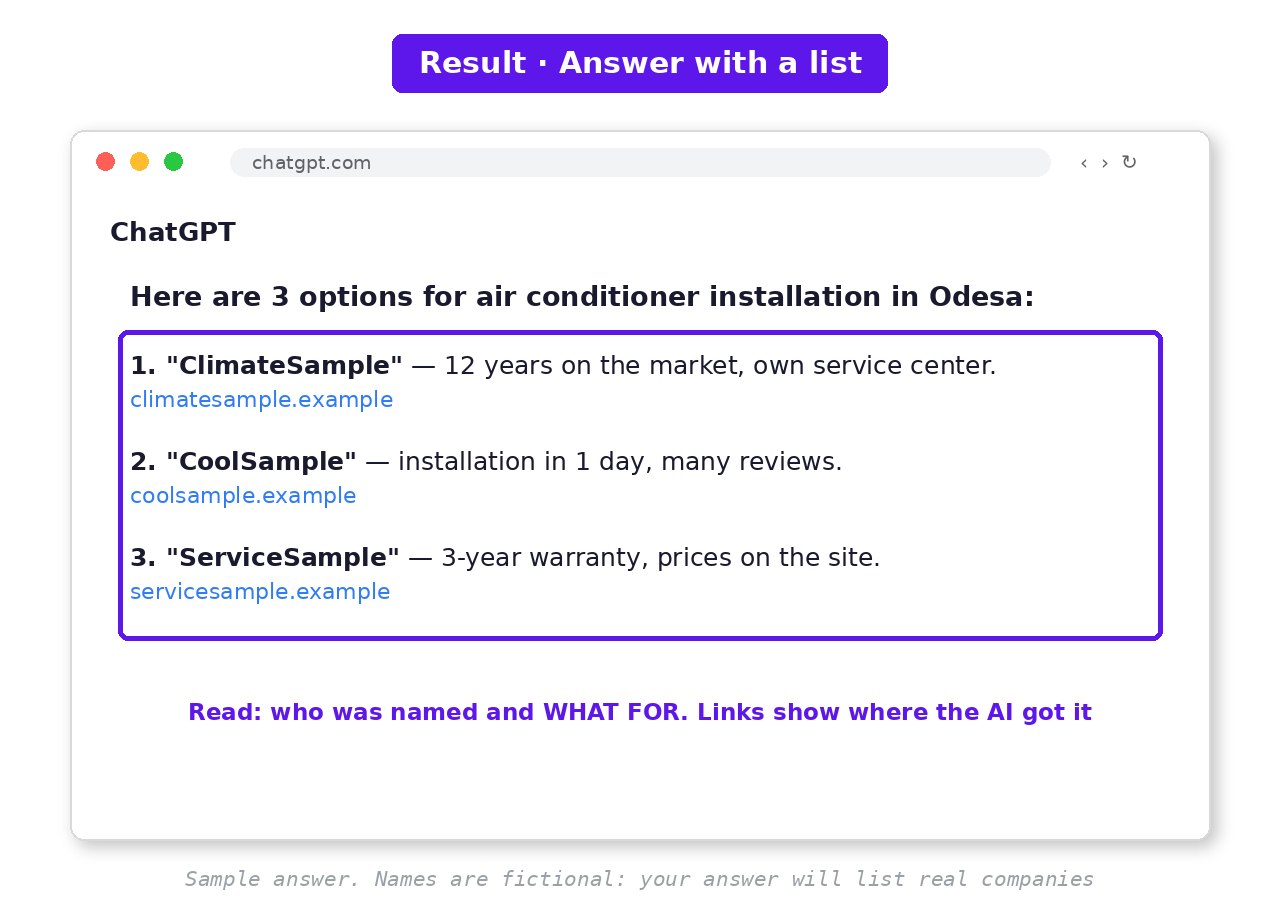
Scenario 1. You were named
Look not at the fact, but at the reason. What exactly were you named for: which facts and links did ChatGPT cite about you?
That is your asset. Those facts and pages are what the AI already relies on. Strengthen them — do not rebuild them.
Check accuracy too: if it wrote something about you that is not true, that is a finding as well. The AI repeats what it found. An error in the answer usually means an error somewhere on your pages.
Scenario 2. Only competitors were named
Do not close the tab. This is the most useful of the three answers.
Write down who was named. And most importantly — what for: which facts, reviews, pages and links ChatGPT cited for each of them.
That is the list of what is missing about you on the internet. Not "competitors are better". But "there is citable data about competitors — and about you there is none, or too little".
Scenario 3. Nobody relevant was named
Generic words. Not a single specific name. Or names outside your niche.
That means the AI has almost no data on your niche. That is an answer too. And a window of opportunity: the niche is not yet taken, and claiming a place in it is easier than fighting established competitors for theirs.
---
Three self-check mistakes
Mistake 1. Checking while logged in as yourself. ChatGPT remembers your conversations and adapts to you. A logged-in answer is an answer to a friend, not to a client from the street.
Mistake 2. Writing your own name in the query. "Recommend company X or someone else" is not a check — it is a hint. The AI will name you, and you will learn nothing.
Mistake 3. Drawing conclusions from one query. One query is one slice. One question. One phrasing. You are absent in this phrasing today — that is a fact. But it is not statistics for the whole niche. Do not confuse a quick test with a full measurement.
---
What one check will not show you
The self-check answers one question: "Did ChatGPT name me in this exact phrase, right now?"
It does not answer the others. How often you are named across different phrasings. What Gemini answers. What Google search shows. Who is named instead of you systematically, not once. And most importantly — what to fix first.
The full "Tochka A" audit is dozens of such queries across ChatGPT, Gemini and Google search. With a breakdown: who is named instead of you, why them, and what to do first. Not one slice — a map of the whole niche.
The self-check is a thermometer in your hand. The audit is a full examination. Do not confuse the two.
---
FAQ
Why can't I check while logged in?
Because ChatGPT knows you: it remembers your chats, topics, and details about your business. It may name you from the context of your own conversations. A walk-in client has no such context. Incognito and guest mode remove that "politeness".
ChatGPT named me but wrote something untrue. What now?
Write down exactly what is wrong. Then find where it could have come from: your site, directories, old pages, third-party mentions. The AI does not invent from thin air — it assembles its answer from data it found. You fix the source, not the chat answer.
I was not named. Is that a disaster?
No. It is a diagnosis, not a verdict. The most common reason is simple: there is too little citable data about you, and enough about your competitors. That can be fixed. But first, write down who was named instead of you — and what for.
Is one check enough?
Enough for a quick yes-or-no. Not enough for conclusions about your niche. Different phrasings give different answers, and there are also Gemini and Google search. The full picture takes dozens of queries, not one.
I work online, with no city. What then?
Replace the city with the format and topic. Like the step 3 example: "a psychologist who works with anxiety, online". The logic is the same: service + the context a real client asks in.
Check in ChatGPT or in Google?
For a self-check, ChatGPT is enough: it is the fastest slice. But clients also ask in Gemini and in Google search — and the answers there may differ. A full audit checks all three systems.
Can I just "ask" ChatGPT to name me?
Not directly. You cannot negotiate with the AI or pay it for a mention. It names those about whom open sources hold enough connected facts: pages, reviews, mentions with links. Data works. Requests do not.
What should I do after the self-check?
Three actions. Save the answer: who was named and what for. Check the links ChatGPT cited — about you and about competitors. And decide whether you need the full picture. If yes — see the "Tochka A" audit block below.
---
Sources
- ChatGPT (guest chat access): https://chatgpt.com
- Google Chrome Help — Browse in private: https://support.google.com/chrome/answer/95464
- OpenAI Help Center: https://help.openai.com
- Ready-made query and query examples: description under the "GEO AUDIT" video (Instagram,
@aievgencreator).
---
Want the full picture? The "Tochka A" audit
You ran a one-phrase check. That is an honest first slice.
The full audit is dozens of queries across ChatGPT, Gemini and Google search. A breakdown: who is named instead of you, why them, and what to fix first.
Message the code word GEO AUDIT in Direct — or leave a request on the audit page: https://ikovalevskyi.com/en/vpk/tochka-a-general
No promises of a "guaranteed place in ChatGPT". Nobody sells such a place. There are numbers, reasons, and a sequence of actions.
---
About the author
Ievgen Kovalevskyi — I have been building websites and running advertising since 2009, and for the last 3 years working with artificial intelligence. I build full multi-agent systems that replace entire departments in businesses and for experts.
*Prepared for the ikovalevskyi.com blog. October 2026.*