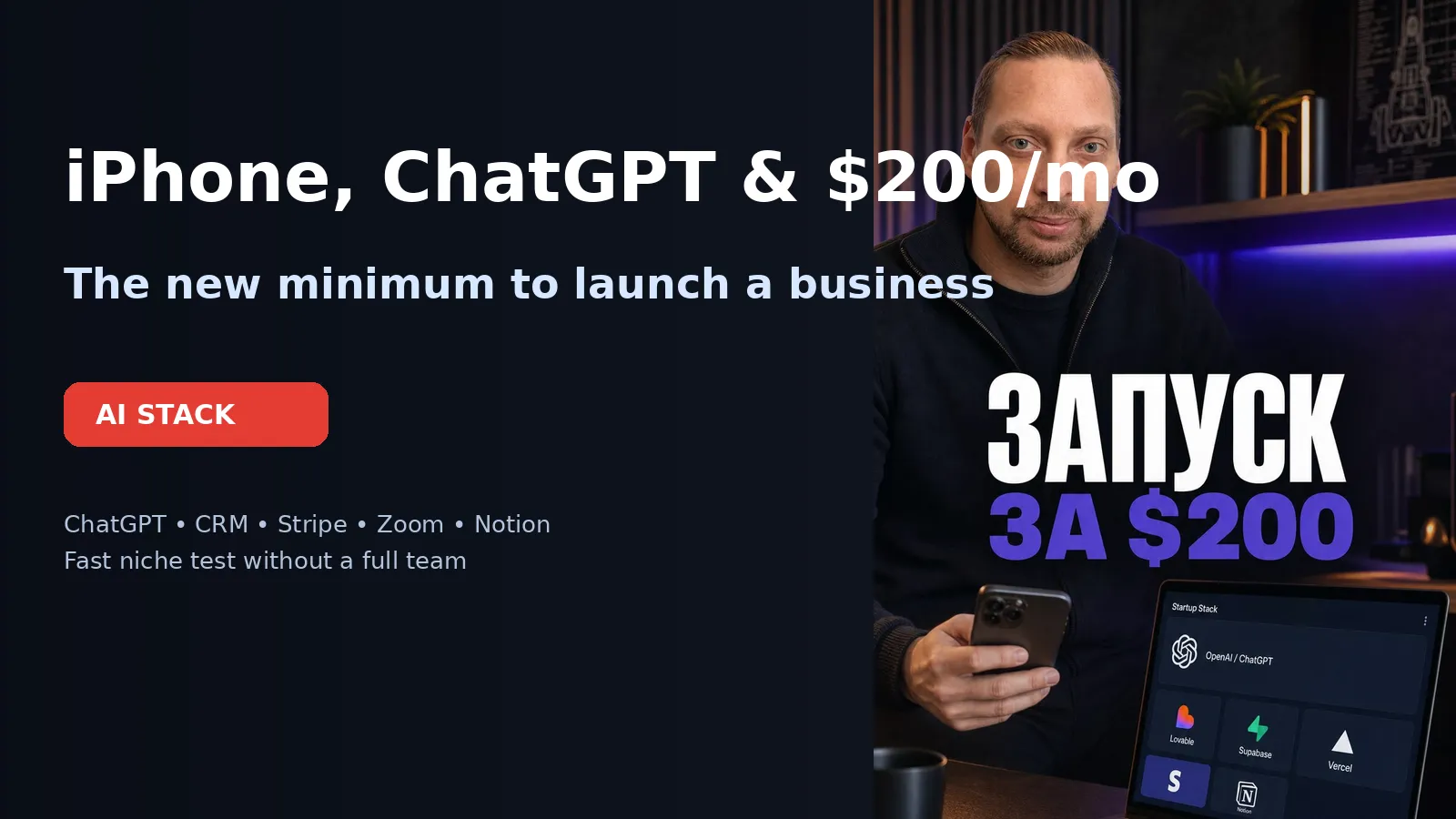
In short: A few years ago, launching a project for the global market meant hiring a developer, designer, marketer, CRM setup, website work, copywriting, and a lot of coordination. Today the minimum stack looks different: an iPhone, ChatGPT, a US LLC, and a handful of tools that cost around $100-200 per month. That does not make business easy. It makes market testing dramatically faster.
The main story is not that GPT got a bit smarter again. The main story is that a founder now gets the kind of speed that used to require a small team.
Today ChatGPT is no longer just a text chat. With connectors and practical workflows, it can cover a large part of the launch layer: landing page drafts, offer framing, sales copy, first process structure, content scripts, and even the first operational scaffolding around a product.
What Actually Changed
A few years ago, even a simple international launch started with a heavy list: website, designer, developer, CRM, payments, calls, knowledge base, content, sales structure. By the time all of that came together, the idea itself could already lose momentum.
Now the starter stack can be much leaner:
- iPhone - to record videos, capture ideas, run calls, and manage everything on the go.
- ChatGPT - to draft the landing page, offer, messaging structure, scripts, and first working materials.
- A US LLC - if you want to think globally from day one and use cleaner payment infrastructure.
- Lovable or a Supabase + Vercel setup - to launch a landing page or lightweight product fast.
- HubSpot or Attio - to avoid losing leads and build order into sales from the start.
- Stripe - to accept payments.
- Zoom - to run sales and discovery calls.
- Notion - to keep the operating system out of your head.
Once these pieces are connected into one working loop, the founder no longer waits for a team to maybe deliver someday. The founder can test the idea directly, with AI as leverage.
Why This Matters Right Now
I do not see this as just another model update. I see it as a lower barrier to entry.
For years, many small and mid-sized founders lost before launch. Not because the idea was weak, but because the setup required too much time, too many people, and too much coordination. That barrier just dropped.
In a single day, you can now:
- test the wording of the offer;
- build a simple landing page;
- describe the product;
- draft a short video script;
- set up the first CRM structure;
- get into the first calls;
- see whether the market responds at all.
That is the real value. Not "AI will build the business for you," but "AI lets you see much faster whether there is a business here at all."
Where Most People Get It Wrong
There is a dangerous illusion here. People see ChatGPT, Lovable, Supabase, Vercel, Stripe, and Notion and start thinking the tool stack itself is almost the business.
It is not.
Tools do not replace the niche. They do not replace customer pain. They do not replace trust. And they do not decide what people are actually willing to pay for.
If the niche is weak, AI will not save it. If the offer is muddy, the landing page will not help. If you do not understand who you sell to and what problem you solve, the best stack in the world will only accelerate chaos.
So the core question is no longer "What else should I connect?" but "What problem am I testing, and how quickly can I get an honest market reaction?"
How I Would Approach a Launch Today
If I were testing a new business idea now, I would do this:
- Pick one concrete niche.
- Define one clear problem to solve.
- Use ChatGPT to assemble a concise offer and landing page.
- Connect the first CRM and payment flow.
- Record a few short videos with an iPhone.
- Start real conversations with the market.
- Only then decide whether to scale, rework, or kill the hypothesis.
This saves not just money. It saves months of life.
Conclusion
Today, a global launch is much cheaper and faster. For roughly $100-200 a month, you can assemble the basic infrastructure that recently required a dedicated team.
But the winner will not be the person who connected the most tools. The winner will be the person who tests the niche faster, hears the market better, and builds without the illusion of "AI magic."
If you want to map the right AI stack for your business, start with a process map and implementation or contact me. Business logic first, tools second.
Lovable for your first website
If you want to build your first website with Lovable, you can register through this partner link. Under Lovable's current terms, the referral may provide additional credits for getting started; the exact bonus depends on the terms in effect at registration.
FAQ
Can you really launch a project today with just an iPhone and ChatGPT?
For a first market test, yes, in many niches that is already enough. But a stable business still needs process, payments, CRM, demand validation, and real conversations with the market.
How much does this minimum stack cost?
If you take a practical starter set, it often lands around $100-200 per month. The exact number depends on your CRM, hosting, payments, and whether you need extra integrations.
What matters more here: the model or the niche?
The niche. The model gives speed, but it does not invent real demand for you. A good niche and a sharp offer beat any stack of tools.
Who benefits most from this approach?
Founders, consultants, service businesses, experts, and small teams that need to test an idea quickly without a long technical runway.