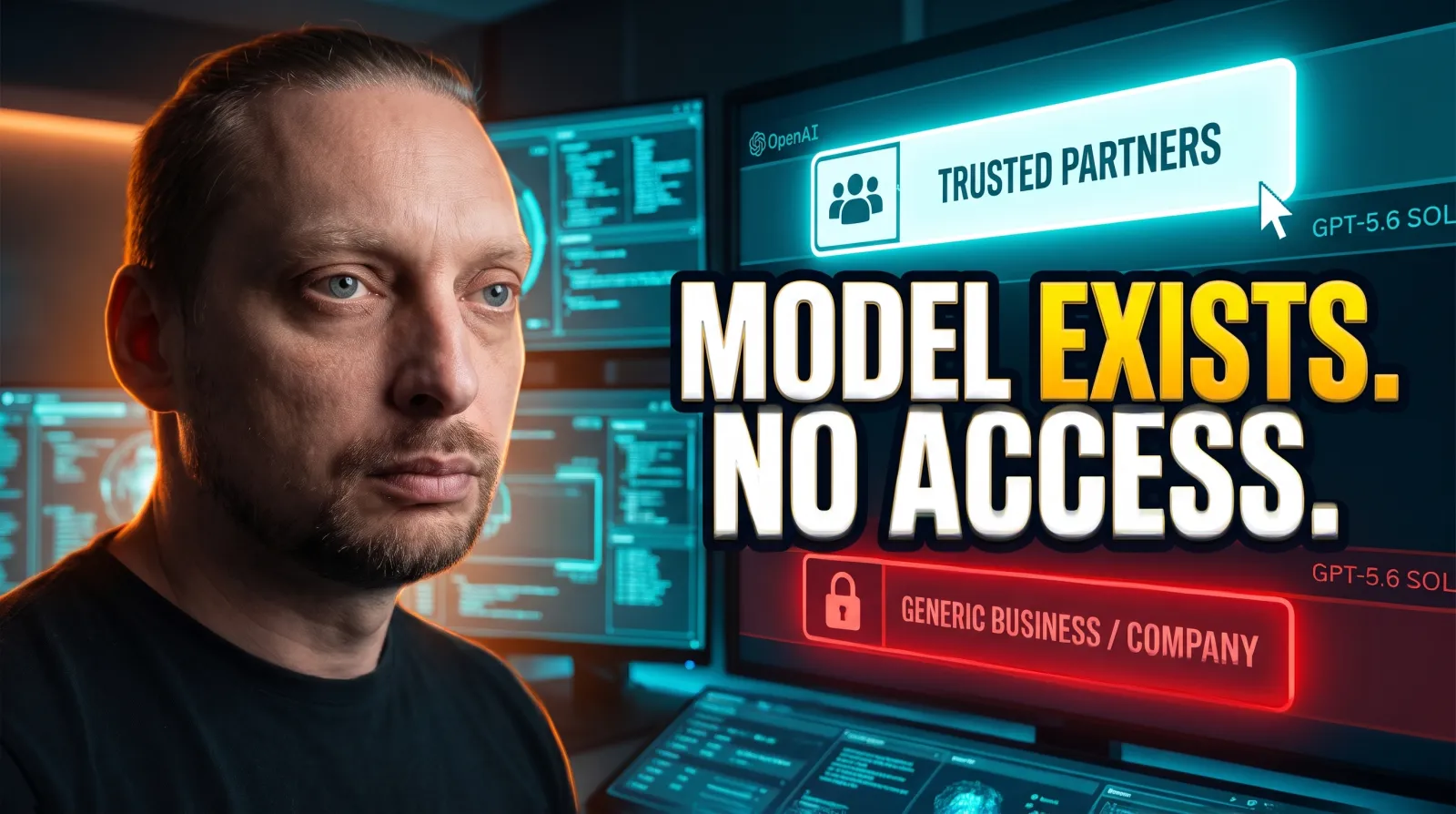
In short: OpenAI is starting a limited preview of GPT-5.6 Sol. Per the company's official post, the model first goes to a small group of trusted partners after a request from the US government, with broader access planned in the coming weeks. This is not a "ChatGPT ban" - it's an important signal for business: the most powerful tool may exist, but access to it may not be given to everyone at the same time.
OpenAI has introduced GPT-5.6 Sol as the most powerful model in the GPT-5.6 line and is starting not with a mass release, but with a limited preview. In its official text, OpenAI writes that after interaction with the US government, the company is starting with a small group of trusted partners, shared with the government, before a broader release.
It is important not to exaggerate. The model is not "banned." OpenAI directly states that it plans to make GPT-5.6 Sol, Terra and Luna broadly available in the coming weeks. But the situation itself reveals a new reality: access to frontier AI can depend not only on a subscription or a business's willingness to pay, but also on rules, security, government frameworks and the partner queue.
What happened
On June 26, 2026, OpenAI published a piece about GPT-5.6 Sol. The company describes Sol as the flagship model, and also mentions Terra and Luna as other models in the line. A specific emphasis goes to stronger cyber capabilities, protection mechanisms, automated red-teaming and gradual rollout.
The most important fragment for business: OpenAI reports that "at their request" it is starting with a limited preview for a small group of trusted partners before broader release. TechCrunch and Axios also described this as a rollout limitation after a US government request.
So the point is not that AI has been stopped. The point is that the newest AI may not come to the world evenly for everyone.
Why it matters for an owner
If your process depends on one model, one platform or one access point, you don't fully control the system. Today the model you need is available. Tomorrow it may be given to selected partners first. The day after tomorrow the integration rules, limits, regions or access for certain tasks may change.
For business, this is not a reason to fear AI. It's a reason to build AI not as a "magic button," but as managed infrastructure.
Normal AI infrastructure has several basic parts: business knowledge, clear rules, output verification, backup scenarios and the ability to replace a model without breaking the process. Then a new model becomes an amplifier, not a point of failure.
Practical takeaway
The question is no longer only which model is the most powerful. The question is whether your business is ready to work with multiple models, knowledge sources and control levels.
If AI answers customers, analyzes documents or helps managers, it should not work "on its own" - it should follow your company's rules. It should know what can be promised to a customer, where a human is required, which data is allowed and how to verify an answer.
That is how AI stops being a dependency on one button and becomes a working system.
What a business should do
- Identify one process that can be given to AI without risk to critical decisions.
- Describe business knowledge for that process: services, prices, FAQ, exceptions, communication style.
- Set rules: what AI does on its own and where it hands off to a person.
- Provide a fallback: another model, a manual path or human review.
- Measure results: response time, quality, errors, leads, routine saved.
Bottom line
GPT-5.6 Sol reveals a new AI reality: the model may already exist, but access may not go to everyone at once. For business, the signal is simple. Don't build a process on a single access point. Build a system: knowledge, rules, backup models, verification.
If you want to figure out which routine in your business can be safely handed to AI, write AGENT in Direct.
FAQ
Was GPT-5.6 Sol banned?
No. According to OpenAI's official post, GPT-5.6 Sol is starting as a limited preview for a small group of trusted partners. The company states that broader access is planned in the coming weeks.
Why was access limited?
OpenAI links the limited start to interaction with the US government, the model's stronger cyber capabilities and a desire to test it with partners before broader release.
What does it mean for business?
A business should not depend on one model or one platform. A more reliable strategy is to build AI processes on your own knowledge base, rules, output verification and backup scenarios.
Sources
- OpenAI - Previewing GPT-5.6 Sol: a next-generation model, 06/26/2026.
- TechCrunch - OpenAI limits GPT-5.6 rollout after government request, 06/26/2026.
- Axios - Trump administration asks OpenAI to limit release of GPT-5.6, 06/25/2026.