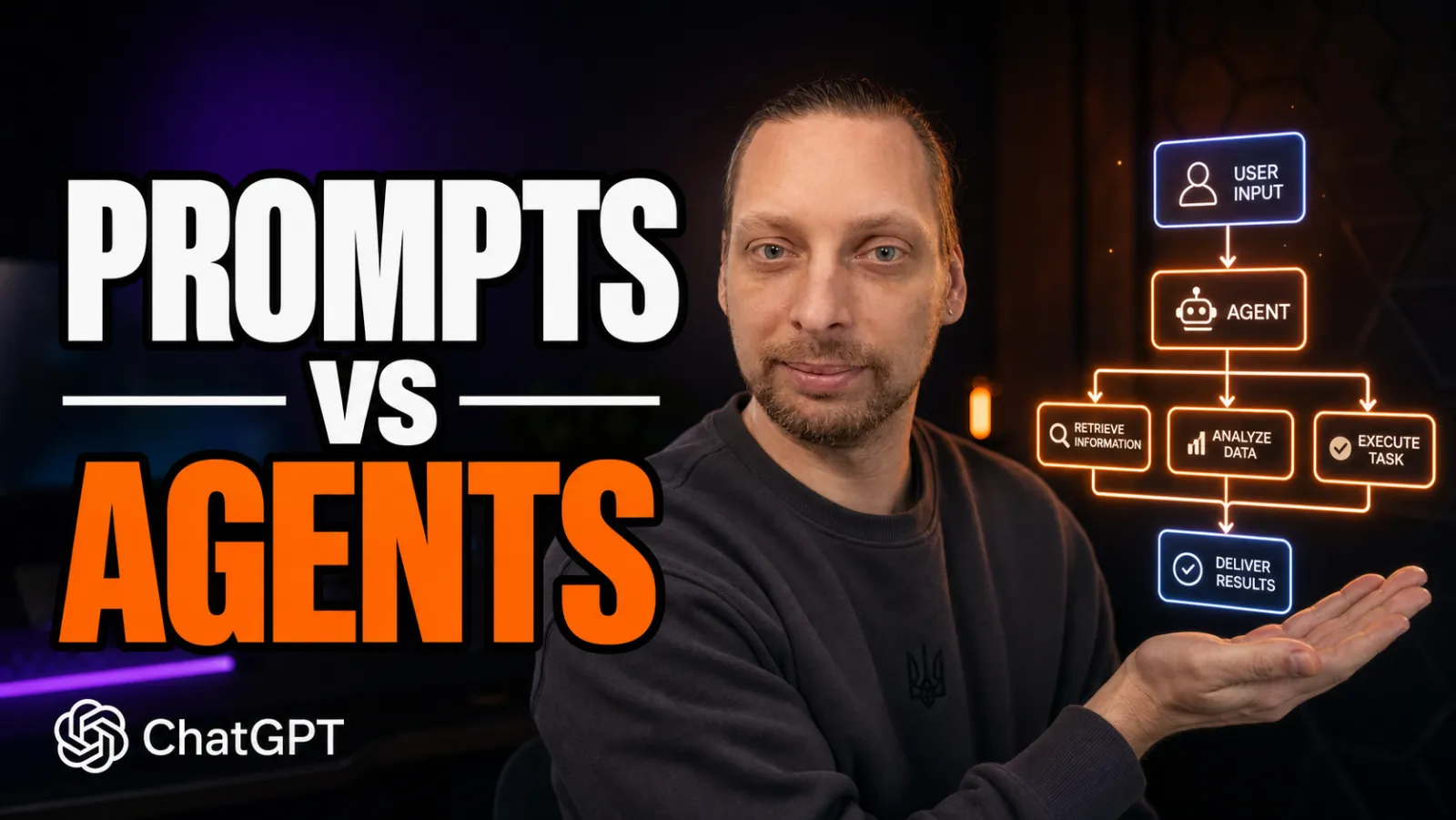
In short: Most business owners already use ChatGPT - they write a prompt, copy the answer, paste it somewhere else, and edit it. That is still "asking AI". The next level is "delegating": an agent finishes the whole process on its own, following your rules and using your knowledge base. According to the McKinsey Global AI Survey (2026), 23% of organizations are already scaling agent systems and another 39% are testing them - almost 6 out of 10 have moved from chat to agents. The key point is control: the agent works autonomously where the data is sufficient and hands the task to a human where it is not.
Let's look at a difference that quietly splits businesses into two camps in 2026. It seems small, but it is exactly where many owners keep losing time every week.
Asking AI and Delegating AI Are Not the Same
When you open ChatGPT, type a prompt, get an answer, and then manually move that answer into an email, spreadsheet, CRM, or document - that is "asking". AI acts like a smart advisor, but you still do the operational work yourself: formulate, copy, paste, check, repeat.
An AI agent is different. In simple terms, an agent is a system you describe once, and then it finishes the process on its own: it receives the task, finds the answer in your knowledge base, prepares the output, and passes it on. The difference between a prompt and an agent is the difference between "I ask" and "I delegate".
Why This Became Important Right Now
In 2026 the market stopped competing only on model size and started measuring something else: how well AI can complete a real business task without constant supervision. That is the shift from prompts to agents.
The numbers point in the same direction:
- 23% of organizations already scale at least one agent system in business, and another 39% actively experiment with them - nearly 6 out of 10 in total (McKinsey Global AI Survey, 2026).
- Knowledge workers using AI save around 6.4 hours per week on average, and several independent 2026 studies converge on a similar range (McKinsey, Salesforce, Slack).
So while some owners still manually copy answers from chat, others have already handed entire chains of tasks to agents and won their time back.
The Main Misunderstanding: "Agent = AI Without Control"
This is the point that stops many owners. An agent is not "magic AI that acts however it wants". The more practical 2026 idea is controlled autonomy - a human still stays inside the decision loop.
In practice, that means:
- the agent works by your rules and on your knowledge base, not on random internet noise;
- where the information is sufficient, it acts on its own;
- where the data is incomplete or the case is sensitive, it asks for clarification or hands the task to a human.
That is how you remove routine work without losing control over quality. This is the core difference between an agent and a generic chatbot.
Where a Business Owner Should Start - Without Chaos
Do not start with a giant system. Start with one repeatable process.
- Pick one process that consumes the most time and repeats often - for example first-line client replies, collecting data for reports, or preparing standard messages.
- Write the rules down: where the information comes from, what the agent may answer, and where a human must always step in.
- Launch the agent on this one process, observe the result for a week, and only then decide whether to scale.
That is the fastest way to see real business value, test the logic, and avoid AI chaos. Industry data suggests the average payback period for an agent is roughly five months, with some implementations paying back sooner.
What This Changes in Practice
The difference between asking AI and delegating to AI is not about hype. It is about how much manual work still sits on you and your team. If you still copy answers out of chat, you spend hours on work that can already run by itself. If you hand the process to an agent, you free that time for sales, clients, and decisions that actually require you.
If you want to identify the first process in your business that can be handed to an agent, send the word AGENT in Direct or through ikovalevskyi.com - I will help you find the best starting point.
FAQ
What is the difference between ChatGPT and an AI agent? ChatGPT answers a prompt, and you still use the answer manually. An agent performs the whole process: it receives the task, finds the required data in your knowledge base, prepares the output, and passes it on while following your rules.
Is it safe to delegate business processes to an AI agent? Yes, if you use controlled autonomy. The agent works inside your rules and approved knowledge sources, while complex or uncertain cases are escalated to a human.
Where should a business start with agents? Start with one repetitive process that takes too much time. Document the rules, run the agent on that process, review the outcome after a week, and only then expand.
How much time can an AI agent save? 2026 studies show that AI users save around 6.4 hours per week on average, but the exact number depends on the process and how repetitive it is.
How much does an AI agent cost and when does it pay back? The cost depends on the process complexity. Industry data suggests an average payback period of around five months, with some implementations paying back faster. The real number must be calculated against your own workflow.
Sources
- McKinsey Global AI Survey 2026 (as cited by industry aggregators AI Business Weekly and Digital Applied)
- mean.ceo, AI Automation Trends, July 2026
- Communication Square / STARTUP EDITION materials on agent workflows, July 2026