When a contractor launches Google Ads or claims a Google Maps listing, the expectation is straightforward: the phone will ring, the schedule will fill with jobs, and the business will grow predictably.
In reality, the outcome is frequently disappointing: ad spend is consumed, clicks roll in (often at \$30–40 per click in competitive Home Services markets), but qualified bookings remain scarce or unprofitable.
The default reaction from most business owners is predictable: *“Google Ads doesn't work,” “The traffic quality is terrible,”* or *“Another agency burned my money.”* But when you inspect the analytics and walk the customer journey step by step, the actual root cause surfaces: Google Ads did its job by delivering an interested buyer. The lead was lost immediately after the click because there was no operational system to catch it.
If you search for any trade service in Google Maps right now (garage door repair, roofing, emergency plumbing, HVAC), roughly one in three listings is an invisible ghost profile. There is no working website link, no recent project photos, and no customer reviews. Just a business name and a phone number.
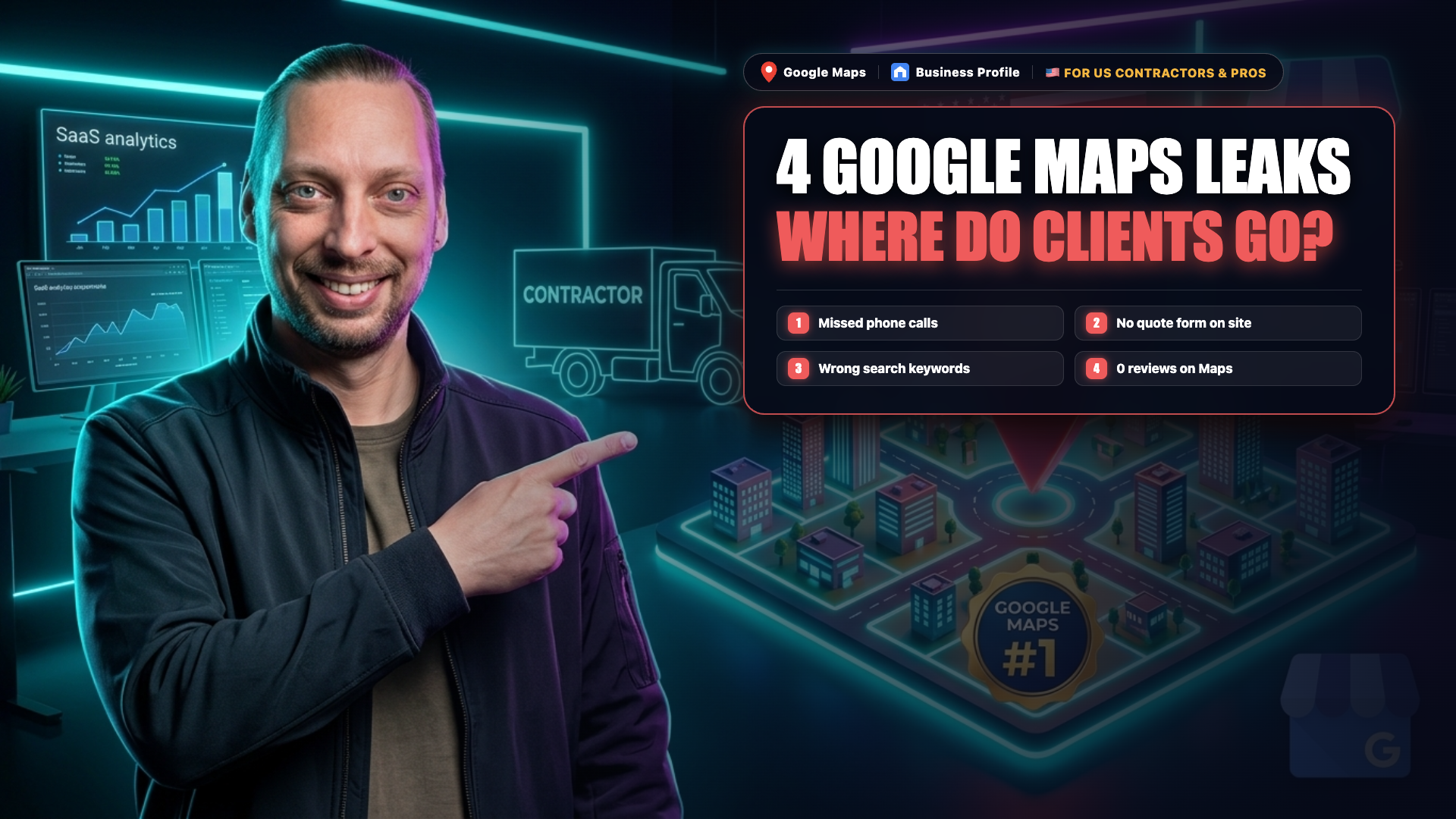
In short: Paid advertising only buys initial attention. Turning that attention into booked revenue requires four operational pillars: an instant automated response to missed calls, a friction-free form for people who cannot call, an exact match between search intent and page copy, and an active Google Business Profile backed by authentic reviews.
Here is a practical breakdown of the four critical funnel leaks draining contractor budgets every day—and the exact steps required to fix them permanently.
---
Leak 1. Missed Calls: When Your Hands Are Busy, the Job Goes to Your Competitor
This is the standard reality for trade businesses: you are on a job site, up on a ladder, replacing a garage door torsion spring, wiring a panel, or soldering a pipe. Your hands are covered in grease, power tools are running, and your phone buzzes inside your work jacket. Picking up is physically impossible.
What does the homeowner do in that moment? They are dealing with an urgent situation: water is leaking through the ceiling, the garage door is stuck with their car trapped inside, or the heater died in freezing weather. They will not leave a voicemail, and they will not wait three hours for a callback. They simply return to Google Maps and tap the very next phone number on the list.
The Numbers That Surprise Business Owners
Most owners genuinely believe they never miss an incoming opportunity. Independent call analytics reveal an entirely different picture:
- Invoca Home Services Benchmark: across the service sector, approximately 27% of all inbound calls go completely unanswered. That means more than one in four paid prospects never even connects with your business.
- Service Direct Call Performance Report: when surveyed, home service contractors estimated that they answer 97% of incoming calls. When independent call tracking and call recording were installed to measure actual performance, their real answer rate was only 66%.
Contractors assume they answer almost every call, but in reality, one out of every three paid opportunities is lost before a conversation ever starts.
Contractor Perception: [███████████████████░] 97% answered
Measured Reality:      [█████████████░░░░░░░] 66% answered
1 out of 3 paid calls lost
How to Fix This Leak
The answer is not trying to juggle power tools with one hand. It is setting up basic call automation via your virtual PBX, VoIP provider, or CRM:
- Instant Auto-SMS within 60 Seconds: if a call goes unanswered after four rings or is declined while you are working, the system instantly triggers an automated text message:
> *“Hi! I'm currently on a job site with power tools running and couldn't pick up. Please text me briefly: what seems to be the issue and what city/neighborhood are you located in? I'll be clear in 15 minutes to provide an estimate and arrival window.”*
- The Business Result: the homeowner sees an immediate response, feels acknowledged, and stops dialing down the Google Maps list. They text their address and describe the problem. The job stays yours.
- Smart Spam Filtering: modern local automation tools automatically weed out robocalls and telemarketers, ensuring auto-replies are dispatched strictly to legitimate mobile callers.
---
Leak 2. Clicks Without a Lead Form: Why You Need a “Second Door”
A widespread mistake among local contractors is sending paid traffic exclusively to a phone number or a bare Google Maps listing without a dedicated web page.
Consider real homeowner behavior: it is 9:00 PM, the kids are asleep, or the client is sitting in an office meeting. The water heater is making strange noises or a faucet is dripping. Making a phone call is awkward, noisy, or undesirable.
The homeowner wants to open a quick page, attach a photo of the problem, enter their address, and request an estimate. But there is no form. Only a phone number. What happens? They close the tab, find a competitor offering a simple online quote request, and your \$35 click turns into a donation to Google.
A Lead Form Is the Alternative Entrance to Your Business
If a phone call is your front door, a web form is the second door through which 30% to 50% of qualified local clients prefer to enter.
You do not need a bloated 20-page corporate website with drone footage and heavy 3D animations. To convert local search traffic, you need a lightweight, fast-loading mobile landing page that answers four fundamental questions within the first five seconds:
| First-Screen Element | What the Visitor Sees | Why It Is Critical |
|---|---|---|
| 1. Service Scope | A clear bulleted list of specific repair jobs | The prospect immediately confirms whether you handle their exact problem |
| 2. Service Radius | Listed cities, counties, and coverage areas | Eliminates doubt about whether you travel to their specific neighborhood |
| 3. Prominent Call Button | One-tap click-to-call button | For emergency callers who need immediate assistance |
| 4. Direct Quote Form | “Describe the issue & attach a photo for a quick estimate” | A low-friction path for prospects who prefer text and online quotes |
A simple, fast-loading mobile page without corporate fluff consistently outperforms expensive agency websites where contact information is buried inside complex navigation menus.
---
Leak 3. Search Intent Mismatch and Delayed Follow-Up
The third budget leak happens when the contractor's technical terminology clashes with how regular homeowners search.
Contractors often label their services with broad trade categories: *“General Plumbing Services”* or *“Complete Roofing Solutions”*.
Homeowners experiencing an emergency do not type generic category names into Google. They type exact symptoms:
- *“water heater leaking at bottom”*;
- *“emergency pipe repair near me”*;
- *“garage door off track repair”*.
When a user clicks an ad and fails to see their specific symptom addressed on the very first screen, they experience immediate cognitive disconnect and bounce within three seconds.
Search Query Intent:  “Garage door torsion spring replacement”
Page Headline:        “Full-Service Contracting Across the Metro Area”
Outcome:              Context Disconnect -> Bounce -> Wasted Ad Spend
How to Uncover Real Customer Phrasing in 10 Minutes (Free)
You do not need an expensive SEO agency to speak your customer's language:
- Google Autocomplete: type your core service into Google and note the exact phrases the search engine suggests automatically.
- “People Also Ask” Boxes: review the related questions Google displays—they reflect the exact pain points people search before hiring.
- Past Invoices and Customer Conversations: recall your last ten customer calls. What exact words did they use to explain what was broken? Those exact words should form the subheadings on your landing page.
Response Speed: The 60-Second Principle
Suppose a prospect completes your quote form. If the inquiry arrives at 12:00 PM and you return the message at 6:00 PM after wrapping up your workday, that lead is already dead.
According to landmark research published in the Harvard Business Review (“The Short Life of Online Sales Leads”), businesses that contact an online lead within the first hour are 7 times more likely to have a meaningful qualification conversation than those who wait just 60 minutes. After 24 hours, conversion chances plummet by more than 60 times.
In local contracting, homeowners rarely submit one inquiry. They open three browser tabs and request quotes from three different providers simultaneously. The contractor who acknowledges the request first almost always wins the job.
First Response Speed:
< 5 Minutes:   [████████████████████] Peak conversion to booked job
1 Hour:        [██████░░░░░░░░░░░░░░] Success probability drops 7x
> 24 Hours: [█░░░░░░░░░░░░░░░░░░░] Prospect has already hired another proTwo Essential Ground Rules for Local Automation
- One Automated Confirmation + One Polite Follow-Up: when a lead submits a form, send an instant automated text within 30 seconds: *“Thanks for reaching out! We received your request, are reviewing the details, and will reach out shortly with an estimate.”* If the client does not respond, send exactly one polite follow-up the next day. If there is still no reply, let the contact go. Repeated automated messaging turns your brand into unwanted spam.
- Fact-Check AI Copy: if you utilize AI tools to write website copy or profile descriptions, verify every single claim. Language models frequently inject fabricated assertions like *“Over 25 years of trusted craftsmanship”* for a business incorporated last year. Local customers spot exaggeration immediately, destroying trust on the spot. Stick strictly to real experience, genuine job photos, and verified service zones.
---
Leak 4. Empty Google Maps Profiles and the Missing Review Engine
When customers evaluate a local contractor on Google, they are not swayed by self-praise on a website. They look for independent verification that choosing you is safe.
According to the BrightLocal Local Consumer Review Survey 2025, 71% of consumers regularly or always read online reviews before deciding to work with a local business.
A common pattern among skilled tradespeople: you finish a high-quality job, the homeowner is thrilled, shakes your hand, pays the invoice, and walks away. You pack your tools and head to the next site. Six months pass, and your Google Business Profile remains stagnant with three outdated reviews from 2022.
Meanwhile, a nearby competitor maintains 94 reviews with fresh photos posted this week. Who will the next homeowner call?
The 24-Hour Review Collection Protocol
Requesting a review two weeks or a month later is ineffective: the emotional satisfaction has faded, and the homeowner has moved on to other concerns.
The optimal window to request feedback is on the day the project is completed, roughly one to two hours after departure:
- Send a short, personalized SMS with a direct link to your Google review submission window:
> *“Hi Mark, thank you for choosing our team today! Glad we could get your garage door running smoothly again. If you're happy with the work, would you mind leaving a brief review on Google using this link: [link]? It takes about 60 seconds and helps other local homeowners find a trusted technician.”*
- The Local SEO Signal Booster: encourage the homeowner to mention their neighborhood and upload a photo of the completed installation. Google's ranking algorithms process image metadata and review text: these location-specific customer contributions directly strengthen your ranking visibility in that exact geographic zone.
---
Actionable Audit: 7-Point Google Business Profile Checklist
Complete this checklist today. It takes 15 minutes and highlights exactly where your profile is losing local ground:
- Precise Primary Category: the single most influential ranking factor in local search. Avoid vague classifications. If you perform plumbing repairs and drain clearing, select
Plumberas your primary category, not genericContractor.
> *Tip:* use free browser tools (such as GMB Everywhere) to inspect the primary category used by the top-ranking competitors in your market.
- Accurate Service Area (SAB): if you travel to client properties, specify only the cities, suburbs, and ZIP codes you can realistically reach within 30–60 minutes.
- Honest Business Hours: if you do not answer after 7:00 PM, do not advertise 24/7 emergency service. Unanswered night calls damage user engagement metrics.
- Authentic Job Photos (No Stock Imagery): upload real photos of your branded truck, tools, team in uniform, and genuine before-and-after project shots. Stock photos undermine credibility instantly.
- Detailed Service Catalog: fill out your services tab using the precise phrases homeowners search for when problems occur.
- Direct Link to a High-Converting Landing Page: ensure your website link points directly to a mobile-responsive page featuring a clear quote request form.
- 100% Review Response Rate: respond to every review, positive or negative. Address the customer by name and naturally incorporate the service performed and city name in your reply.
---
Bonus: The \$15 Domain Policy That Insures Your Business
One of the most damaging scenarios I encounter during audits: an owner invests in local advertising, brands their fleet, distributes thousands of flyers, and collects positive reviews over five years. Eventually, they change web developers or agencies—only to discover their domain was registered under the developer's personal account.
Disagreements arise, the relationship ends, and the business owner suddenly loses access to their domain name, corporate email, analytics history, and years of accumulated search authority.
The Golden Security Rule: Always register and renew your domain name under your own direct ownership:
- registered to your personal or primary corporate email;
- billed to your own company payment card;
- third-party agencies and freelancers receive delegated access (via DNS management like Cloudflare or registrar delegate access), never ownership rights.
A domain costs \$12–20 per year. It represents the single most affordable insurance policy protecting your digital assets from human error and ownership disputes.
---
Four Holes Are Not Separate Issues—They Are One Missing System
When you connect all four points:
- Missed calls without an automated text response;
- Traffic sent to a phone number without an estimate form;
- Search terms that do not match page messaging, paired with slow follow-up;
- An inactive Google Business Profile without systematic review collection.
It becomes evident that these are not isolated technical glitches. They are symptoms of operating without an integrated local acquisition system.
Attempting to patch these leaks individually through trial and error consumes time and continues to waste paid clicks every day.
To implement a structured, reliable marketing architecture and stop wasting ad budget, consider a proven next step:
Personal [Google Ads Campaign & Funnel Audit](/en/google-ads-audit): If you currently run Google Ads or maintain a local listing but your cost per booked job is too high, I will personally examine your entire acquisition pipeline (campaign architecture, conversion tracking, search terms, landing page, and Maps listing) to identify precise spend leaks without unnecessary sales pitches.
---
Research Citations and Data Sources
- Invoca Research: *“How Many Phone Calls Are You Missing? Home Services Industry Benchmark”* — study analyzing call answer rates across home service providers (27% missed call rate).
- Service Direct Benchmark: *“Home Service Call Performance Report”* — comparative analysis of contractor self-reported answer rates (97%) versus measured reality (66%).
- Harvard Business Review: *“The Short Life of Online Sales Leads”* (James B. Oldroyd, Kristina McElheran, David C. Elkington) — analysis of lead response speed and meaningful contact rates (7x higher qualification rate when contacted within the first hour).
- BrightLocal: *“Local Consumer Review Survey 2025”* — annual consumer research measuring the impact of Google reviews on local business selection (71% of consumers regularly read reviews).
- Author Field Experience: internal benchmarks and deployment procedures developed while managing local Google Ads and Google Business Profile campaigns since 2009.
---
FAQ
Why do paid clicks from Google Ads fail to convert into booked jobs for contractors? Google Ads successfully drives targeted traffic, but leads are lost inside the local funnel due to 4 operational leaks: 1) missed phone calls without automated SMS response (up to 27% loss according to Invoca); 2) absence of a straightforward quote request form on the landing page; 3) page copy mismatching specific customer search terms (e.g., 'plumbing' vs 'water heater repair'); 4) an unverified or empty Google Business Profile with no recent reviews or authentic project photos.
How can a contractor capture leads when their hands are busy on a job site? Implement an automated missed-call text-back system within seconds of a missed call: 'Hi! I am currently on a job site with my hands full. I will call you back within an hour — feel free to text what you need fixed and I will give you an estimated price.' Harvard Business Review research shows that contacting a lead within the first hour makes qualification 7 times more likely.
What 4 elements must a contractor's landing page display within 5 seconds? A high-converting contractor landing page requires only 4 essential elements: 1) a clean, bulleted list of specific services; 2) the exact cities and zip codes served; 3) a prominent 'Call Now' click-to-call button; 4) a frictionless 'Describe your job — Get an estimate' form. Without a form, after-hours clicks costing $30–$40 are wasted.
What is the 7-point audit checklist for a Google Business Profile? The checklist consists of: 1) precise primary business category (verified with tools like GMB Everywhere); 2) accurately defined Service Area; 3) verified operating hours; 4) genuine on-site project and branded vehicle photos (zero stock images); 5) service listings matching exact search queries; 6) a direct link to the quote request landing page; 7) consistent responses to all reviews incorporating relevant service keywords.
Why must a business owner register their domain name under their personal account? Your domain name is the core legal digital property of your business. If a web agency or contractor registers the domain in their own name, you risk losing your website, search rankings, reviews, and customer trust should you ever part ways. Always purchase your domain directly for $15–$20/year using your personal email and credit card.