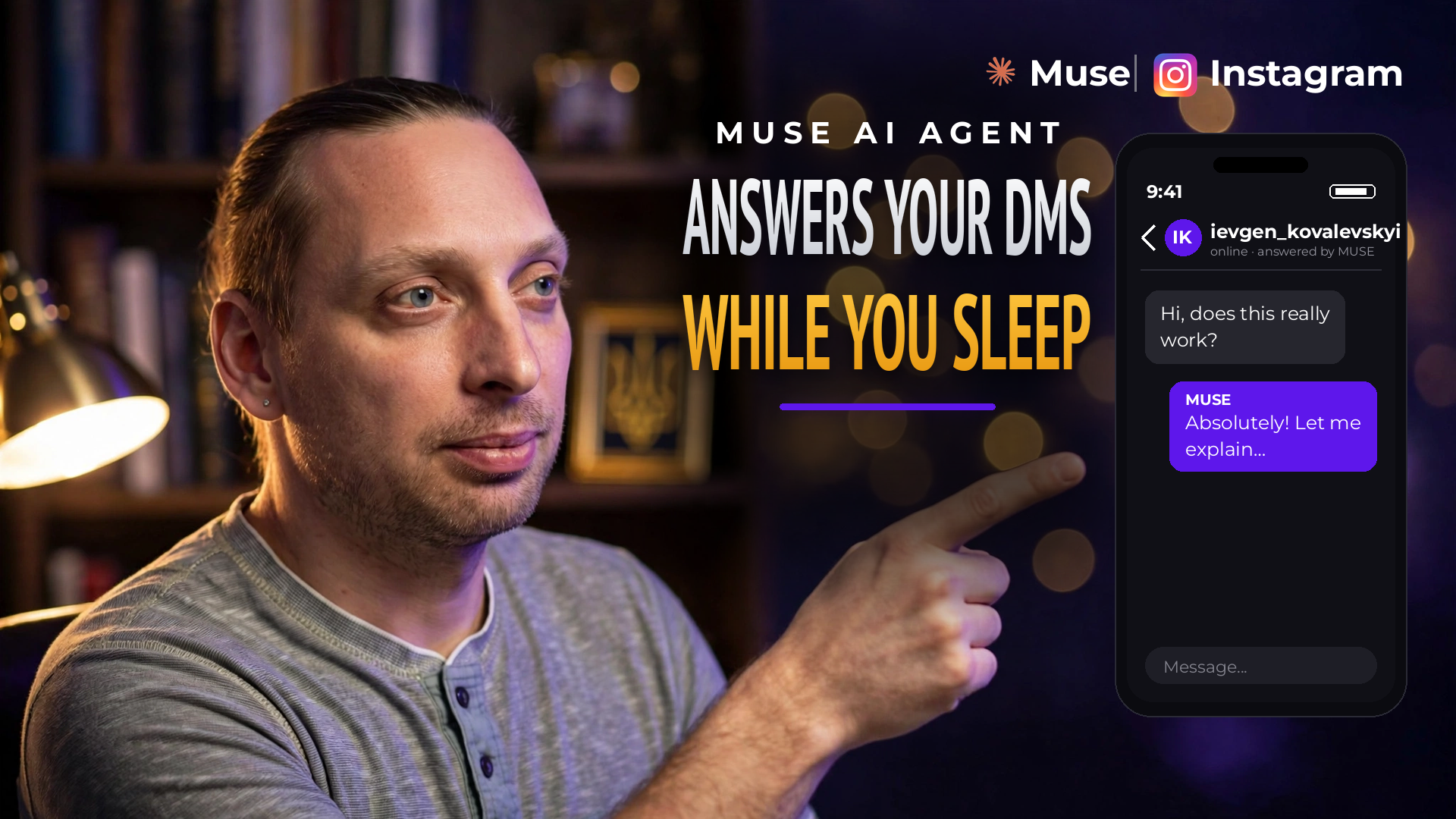
Yes, it is possible. In a single evening you can set up an AI agent that connects to your Instagram Direct and answers clients in your tone of voice — including at night, while you sleep. I did it for my own Direct, and in this article I will show you how it works in practice: what the agent does well, where it absolutely needs a human, which mistakes turn a helper into a "robot" — and I will give you the exact 3-step setup instructions.
The inquiries you never see
Nearly half of all business inquiries arrive when you are not around. According to the AnswerConnect call center (September 2026), 47% of calls to US companies come outside classic working hours — evenings and weekends. Instagram Direct is no different: a client writes at 11:40 pm, you answer in the morning, and by morning they have already closed a deal with whoever answered at night.
The cost of delay was measured long ago and precisely. A study led by Dr. James Oldroyd (MIT, 2007; over 15,000 leads and 100,000 calls across six companies) found: if you reach a client within 5 minutes instead of 30, your odds of establishing contact are 100 times higher, and your odds of moving the conversation to substance are 21 times higher. First-response speed beat every other factor, including the day of the week and the time of day.
Silence is not a neutral "they will wait." According to Sprout Social, 73% of consumers will buy from a competitor if a brand does not answer their questions on social media. And a Harvard Business Review audit back in 2011 recorded the average business response time — 42 hours, with 23% of companies never answering at all.
What changed in September 2026
On September 29, 2026, Meta opened its Muse AI agent to small businesses — Reuters reported it. The agent connects to a professional Instagram account, Facebook Pages and ad accounts, and works with business information: what the company sells, its signature communication style, typical client questions. And one important limitation stated by Meta itself: Muse publishes nothing, sends no messages and makes no purchases without the user's approval.
In other words, a tool appeared that was built exactly for our task: answering Direct on behalf of a business without crossing the line.
My experience: an agent in my Direct
I connected Muse to my Instagram Direct. The agent learned my tone of voice and answers clients in my tone. I like the result.
To be honest: the agent is a tool. It answers exactly as well as it was trained. Below — what it does well, and further down — where it needs a human.
What the agent does well
The agent answers in seconds, around the clock — this closes the main pain: night inquiries no longer wait for morning. It knows your services and prices: the data is pulled at request time, so prices in its answers update themselves, with no manual template editing. It holds the thread of the conversation — it remembers the client's name, past requests and agreements. And it speaks in your tone — if it was trained on your real conversations, not on a dry FAQ list.
One line about the law that cannot be skipped: since August 2, 2026, Article 50 of the EU AI Act is in force — a chatbot must tell a person they are talking to an AI system no later than the first interaction. If some of your clients are in Europe, disclosure is a mandatory requirement, not politeness.
How to connect Instagram to Muse in 3 steps
It sounds like you need a developer: APIs, tokens, webhooks. The obvious answer is "this is complicated." Here is the twist: there is no code at all. Three clicks in a browser — and the agent is in your Direct.
Everything is done in the Muse web interface at muse.ai — in the browser, not the app. That is more convenient: in the browser you are already logged into all your social networks, so no passwords to type.
Step 1. Open muse.ai in your browser, go to Settings on the left — the Connections section. Find the Instagram row and click "Connect".
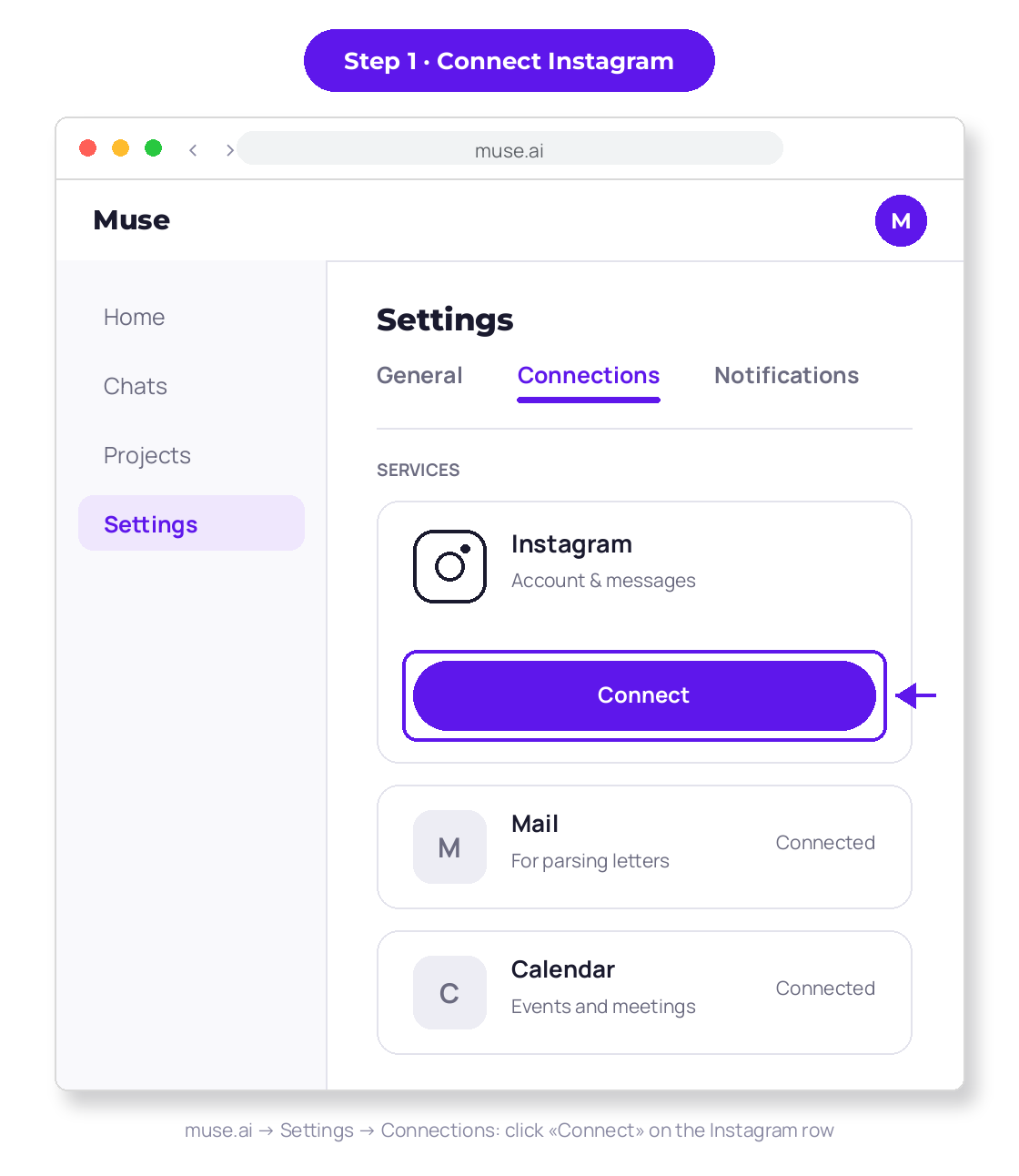
muse.ai → Settings → Connections: click "Connect" on the Instagram row.
Step 2. In the Instagram card, enable "Instagram messages" access — the toggle must be ON.
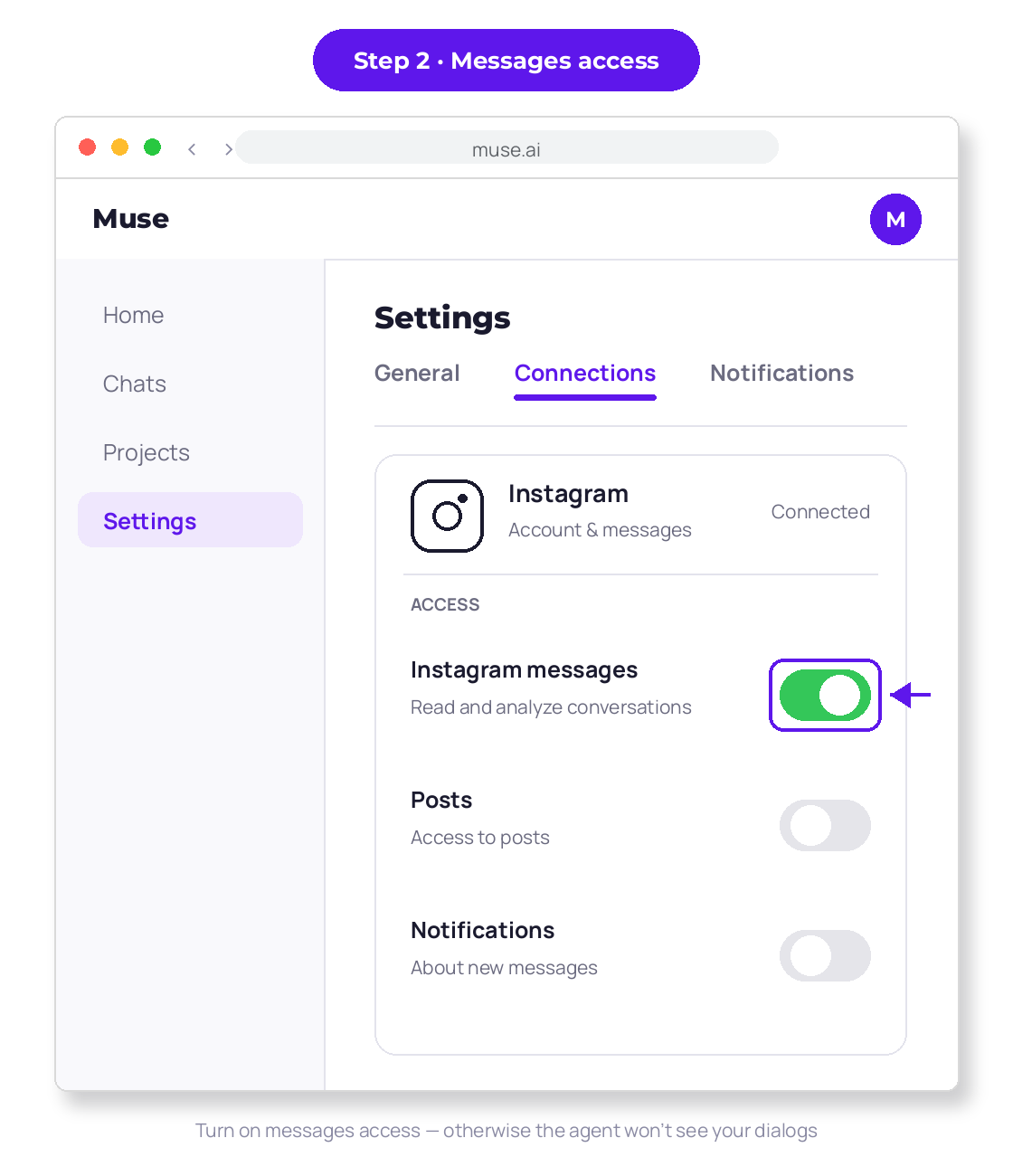
Enable messages access — otherwise the agent will not see your dialogs. It will be connected, but blind.
Step 3. Open a new chat ("+ New chat") and paste the prompt there.
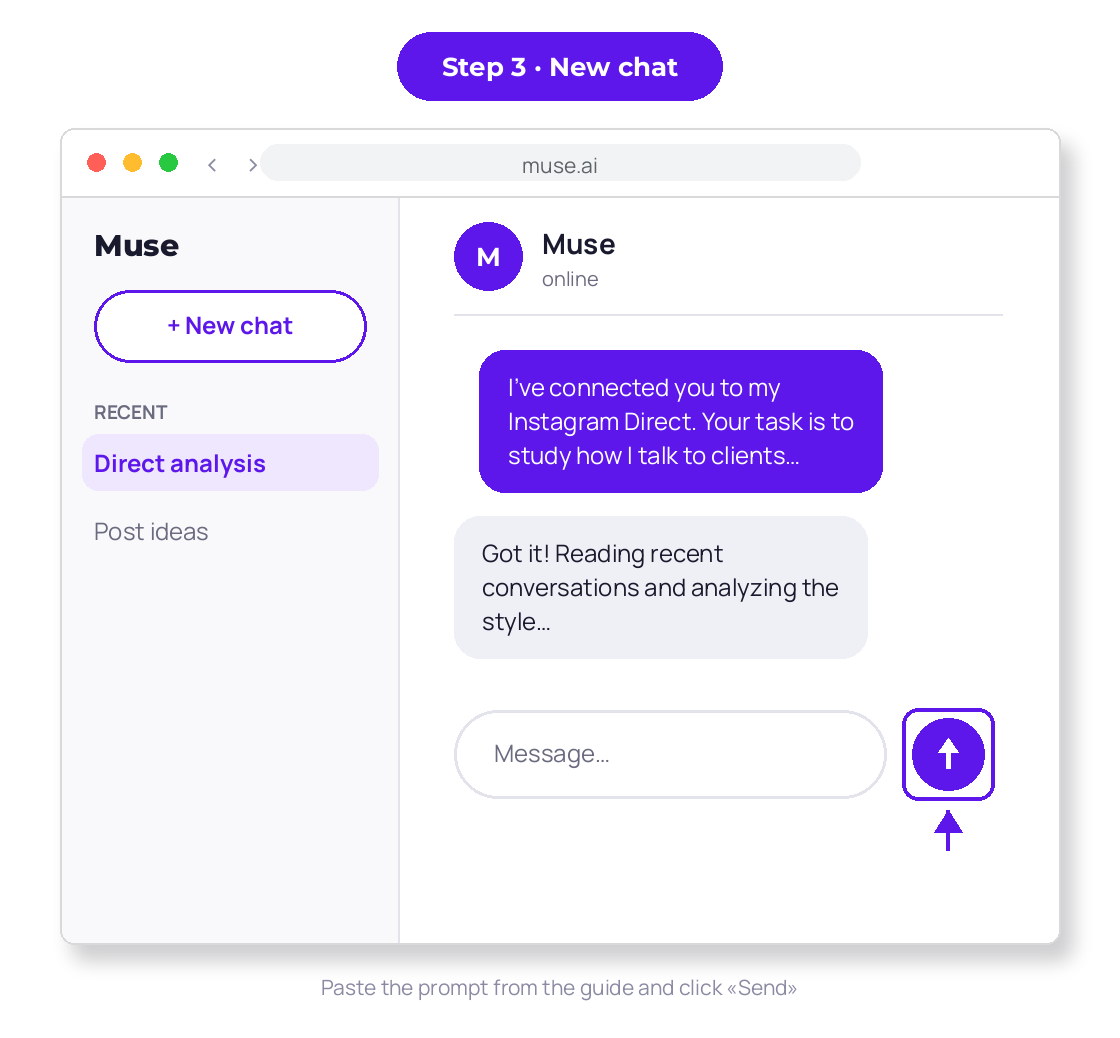
Paste the prompt and click "Send". The ready-made prompt is inside the guide: in 15 minutes it creates InVoice — a profile of your tone, with example phrases for typical client messages. The agent reads your conversations and learns to talk like you.
What to teach the agent — and what not to
The main practical takeaway from all the research: you train the agent not on a polished FAQ, but on real conversations — with typos, slang and genuine client questions. An FAQ gives the agent the right words; conversations give it your manner.
But conversations are only raw material. The next step is to lock in the tone. The guide has a new practical section, "Instagram → Muse → InVoice: 15-minute practice" — with a ready-made prompt: you send it to Muse in a new chat, and it creates an InVoice file — a profile of your tone, with example phrases for typical client messages. What exactly to ask for in the prompt and how to check that the tone came out "yours" — inside.
When a human must lead the conversation
There are topics you must not hand to the agent. A study by Vivek Astvansh on more than 500,000 chats showed: on detailed and sensitive topics — delivery, payments — clients noticeably more often seek a human, not a bot. Human operators matched the client better in substance and style, and that produced a stronger connection.
And one more number about patience: 55.5% of people will disconnect from automated support within three minutes if it makes no progress (Consumer Patience Index, Parloa, June 2026). Speed without meaning irritates more than an honest "let me get a human."
The boundary between "the agent can handle it" and "this needs a human" is the most important part of the whole setup. In the guide it is drawn explicitly: four clear triggers on which the agent must hand the dialog to you, and four duties on such handoff — from the words it must say to the client to stopping the bot itself. The section is called "When the agent hands the dialog to you: escalation rules." That boundary is what separates a helper from a problem.
Why a "warm" bot can repel
Here is a counterintuitive fact that changes how you tune the tone. An international meta-analysis of 327 studies (Journal of Marketing, nearly 282,000 participants) showed: the difference in how people perceive AI versus humans is often smaller than assumed. Clients do not demand that a bot be human.
And a 2026 study (MIS Quarterly, three experiments with a live LLM bot) found the reverse: empathetic bot replies like "I share your frustration" caused psychological reactance — clients perceived the bot as less competent, and their satisfaction dropped. Humanizing is not always the right strategy.
The conclusion is simple: a bot should be useful and honest, not "warm."
What exactly makes an agent a "robot" and why clients feel deceived when they do not understand who they are talking to — is covered in the section "3 mistakes that make an agent answer like a robot." It also includes a scientific breakdown of each mistake: what happens in the client's head and how to fix it in practice.
When this is not for you
Honestly: an agent in Direct is not for everyone.
If Direct messages are rare and you manage to answer yourself — the agent will change nothing. If your sales are built on long personal relationships and live trust, where the client buys you specifically — automating the first touch can hurt. If you are not ready to spend one evening on setup and check dialogs for the first couple of weeks — an untrained agent answers like a robot, and that is worse than answering slowly. If your clients mostly call rather than write — close the phone channel first; Direct can wait.
What is inside the full guide
Everything step-by-step is in the PDF guide, assembled as a one-evening instruction: first the theory — six sections (how the agent understands your services and prices; training on your conversations; reply scripts for 7 typical objections; escalation rules; a one-evening launch checklist; 3 mistakes that make an agent answer like a robot), then the new practical block "Instagram → Muse → InVoice" — a 15-minute setup: from the connections section to the ready-made prompt that creates your tone profile. Plus a separate bonus block — a code for 1 billion Muse tokens. The number of code uses is limited; in the guide it is framed as "act now" — with no guarantee the code is still active when you read this.
If Muse is not yet available in your country, first read the registration guide (currently in Russian only).
Get the guide
The PDF guide "Muse — the AI agent that answers your Direct while you sleep": 13 pages, a one-evening instruction. Inside — the 3-step setup with screenshots, a ready-made prompt for creating InVoice (your tone profile), reply scripts for 7 typical objections, rules for escalating the dialog to a human, a launch checklist, and a bonus — a code for 1 billion Muse tokens.
To be honest: the guide currently exists in Russian only (file ai-agent-otvechaet-v-direkt-poka-vy-spite_lead-magnet-ru-v4.pdf). The English version is in preparation — we do not invent files that do not exist.
Where to get the guide:
- Telegram — guide post in the @adsiseasy channel
- Instagram — write the code word MUSE in the comments or in Direct to @aievgencreator, and the guide will arrive automatically
Sources
- AnswerConnect: 47% of business calls happen outside working hours
- Lead response time research roundup: MIT/Oldroyd, 2007 — 5-minute contact vs 30 minutes gives a 100x chance
- Sprout Social: social media customer service statistics
- Harvard Business Review, March 2011: "The Short Life of Online Sales Leads" — average response time 42 hours
- Reuters, 09/29/2026: Meta opened its Muse AI agent to small businesses
- EU AI Act, Article 50: chatbot duty to disclose the user is talking to AI
- V. Astvansh study: 500,000+ chats — when customers seek a human, not a bot
- Parloa Consumer Patience Index, June 2026: 55.5% drop off within 3 minutes without progress
About the author
Ievgen Kovalevskyi — building websites and advertising since 2009, and for the last 3 years — artificial intelligence. He creates full multi-agent systems that replace entire departments in businesses and for experts. He connected Muse to his own Instagram Direct himself — the agent answers clients in his tone. Website: Ievgen Kovalevskyi