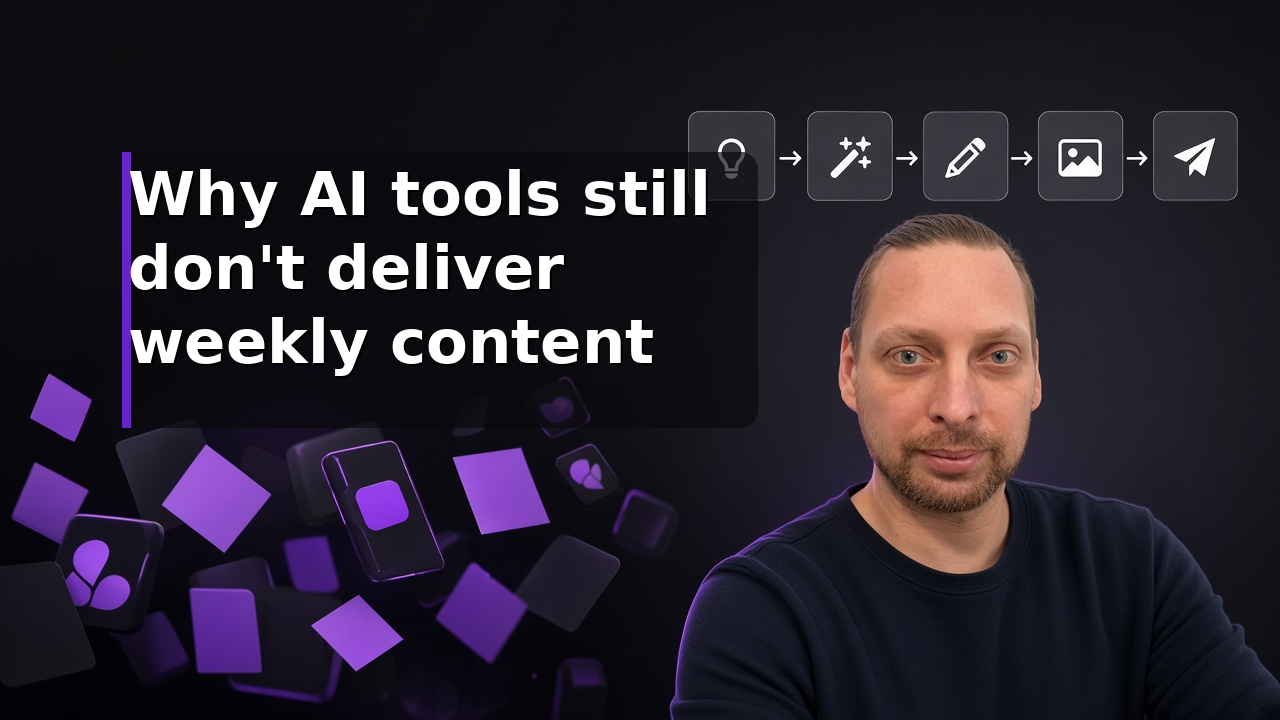
Short version: the problem is rarely “not enough AI.” More often the steps are scattered: idea in notes, production “later,” posting “when there’s time.” A tool speeds up one step. Rhythm appears when the steps are stitched into a conveyor.
More AI subscriptions. Posts still “as it goes.”
A familiar scene: twenty tabs, a draft on the phone, “I’ll publish tonight.” Evening passes. A week with no post. People blame discipline. The break sits in the process: the steps are not one contour.
The market sells services. Rhythm does not appear by itself
Bloggers and roundups keep showing “must-have” tools for scripts, images, cuts, captions, scheduling. Each can help on its own step. Together they often leave the owner with a zoo of windows and separate bills.
This is not lazy-user folklore. In HubSpot’s 2026 State of Marketing, 80% of marketers already use AI for content creation, while 27% name a consistent content schedule as a top difficulty. Tools are present. Rhythm still stalls.
Cost adds pressure. Per Bango (November 2025), the average American pays about $66 a month for roughly four premium AI subscriptions; more than 70% of respondents pay at least $20/month for ChatGPT Plus alone. For a business owner the pattern is the same: every “must-have” service is another invoice and another interface to remember.
Three holes that break the week
1. The idea lives alone
Notes, voice messages, unfinished chats. The idea exists, but it never becomes a brief with facts, angle, and CTA. It stays “I’ll write it later.”
2. Production lives alone
Script in one place, the video “sometime,” edit “when I have an hour.” AI can speed cuts or captions, but it does not stitch approved text into finished files for three networks.
3. Posting lives alone
“When there’s time.” Different captions, formats, dashboards. Even a strong video dies if publishing is a weekend project, not the next conveyor step.
While those three zones stay disconnected, buying another tool barely changes the week. It mostly adds a tab.
A tool speeds a step. A factory stitches steps
The difference is simple.
- Tool: “make me text / image / cut.”
- Conveyor (factory): idea → fact gathering → script → record or AI video → edit → YouTube, Instagram, Facebook → human checkpoints.
In Kit’s 2026 survey, 89.2% of creators always review and edit AI output before using it. That is normal. The question is not “trust the model 100%,” but where the human sits: in chaos between services, or on three short checks.
The practical contour I assemble as a content factory:
- Speak or briefly state the idea.
- The system gathers needed context and facts.
- A camera-ready script comes out.
- Then record with your own voice/face, or send it for video creation.
- Edit and package for the networks.
- Publish.
- A person checks three things: script, edit quality, proof of publish.
Not another link list. A stitch under your brand and rhythm.
When this stitch is not a fit
- If you need a one-off creative “for tomorrow” with no repeat, a single tool may be enough.
- If you will not review the script and say yes/no, automation only multiplies noise.
- If brand voice is not even two sentences yet, lock tone and hard no’s first — or the conveyor will ship foreign text faster.
A factory makes sense where content must ship regularly and the owner wants to keep decisions, not tab-hopping chores.
What to do today, before the “perfect stack”
- Write your real path from idea to published post. Where it breaks.
- Mark three zones: idea, production, posting. Which fails most.
- Drop a service that never fully closes any zone and only “sometimes helps.”
- Define three human checks without which nothing moves forward.
If you want the stage map as a turnkey content factory (idea → script → video → YouTube + Instagram + Facebook), write FACTORY / in Ukrainian threads ЗАВОД in comments or Direct — I’ll send a short stage scheme and how assembly starts for you. No price in this article.
I am Ievgen Kovalevskyi, AI Automation Architect. I build AI agents and automation systems on the data, documents, and processes of a specific business.
FAQ
Why doesn’t more AI guarantee weekly content?
Most subscriptions close a single step. They do not stitch idea, production, and posting into one contour. Rhythm comes from the conveyor, not from tool count.
Can’t I just take a “top 10 tools” list?
A list helps orientation. It does not assemble the process. Without a stitch, each new service adds a bill and context you must re-explain.
Where does the human stay in this contour?
On checks: script, edit quality, proof of publish. The rest of the routine can collapse into one factory line.
Is this only for large teams?
No. It hits hardest when the owner carries content between meetings. Teams also move cleaner when zones are connected, not scattered across chats.
Sources
- HubSpot: 2026 State of Marketing Report
- HubSpot report overview (incl. consistent schedule difficulty): State of Marketing 2026 overview
- Bango / The Desk: Americans juggling four AI-based subscriptions…
- Kit: The State of AI in the Creator Economy (2026 Survey)