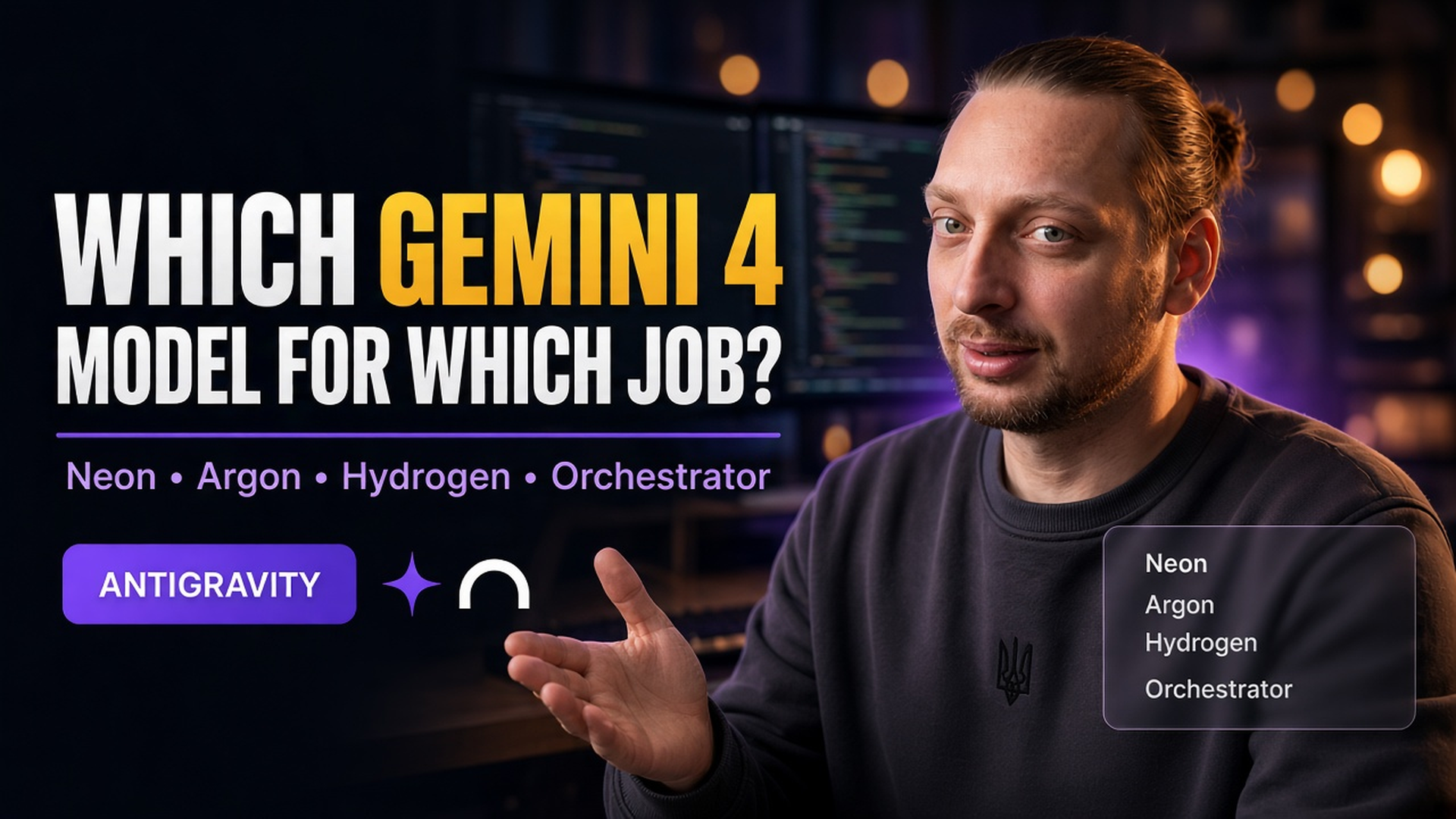
Working in Antigravity and lost in the new models? The picker now shows Neon, Argon, Hydrogen and two Orchestrator options. They all pull from the same weekly quota.
Here is the rule I use. Match the model to the job. Keep the heavy models for work that actually needs them.
The short version: volume hooks and quick copy — Hydrogen. Figuring out which creatives converted — Neon. Planning a full week of A/B tests — Argon. An agency agent or a catalog pipeline — Orchestrator (Neon) or Orchestrator (Argon). Rebuilding your whole testing stack or debugging a broken agent — Carbon, Ultra only.
Below, each model on a real paid-social or e-commerce job: what it does, what it maps to in Claude Code, and how hard it hits your limit.
<!-- VISUAL: images/gemini-4-models-antigravity-01-model-picker.webp — Real screenshot of the Google Antigravity model picker: Gemini 4 Neon, Argon, Hydrogen, Orchestrator (Neon) and Orchestrator (Argon) -->
Why does the Antigravity weekly limit drain so unevenly?
Every Gemini model in Antigravity draws from one shared quota. Google charges it at each model's API price. A model that costs more per token empties the pool faster.
Google's own example: if one model is 8x cheaper than another at API pricing, you get 8x the tokens on it from the same quota.
The picker shows two windows: a five-hour limit and a weekly limit. Claude and GPT models sit on a separate limit of their own.
The other factor is how much work the agent does. Long, multi-step tasks use more quota than a single quick answer, even on the same model.
Which model should write hooks and quick copy at volume?
Hydrogen.
Mid-test on Meta, you need ten fresh TikTok-style hooks for the same offer. Drop in the brief. Hydrogen spins out lines ready for Ads Manager, rewrites the ones you flag, and formats them into a sheet.
In Claude Code, this is Sonnet territory: the model you live on all week. Your limit barely moves. Google positions Hydrogen as the default for everyday work, tool-using agents and parallel subagents, and as the upgrade path from Gemini 3.8 Flash.
Which model can tell you which creatives actually converted?
Neon.
Open last week's creative export from Meta and TikTok. Ask Neon to rank the angles that drove purchases, explain why the losers lost, and draft three variations of the winners to scale. It reads the numbers, groups creatives by angle and hands back a short, defendable verdict.
That is Opus-level depth in Claude Code terms. It eats more of the limit. Save Neon for the analysis that decides where next week's budget goes.
<!-- VISUAL: images/gemini-4-models-antigravity-en-02-neon-creative-ranking.webp — Illustration: Gemini 4 Neon in Antigravity ranking Meta and TikTok ad angles and marking which ones to scale -->
When is Argon the right call?
When the job is long and needs one coherent line of thinking.
You want a full week of A/B ideas across Meta and TikTok before you hit the weekly wall: hypotheses, audiences, creative angles, what to test first and what to kill. Argon holds that long plan together without losing the thread halfway.
In Claude Code terms it sits between Sonnet and Opus. It eats the limit moderately. One clarification: Google calls Carbon its heaviest model. Argon is the one for advanced reasoning with less thinking per turn than Carbon.
How does Orchestrator split one job between two models?
Orchestrator pairs two Gemini 4 models in one conversation. A stronger planner plans and reviews. Fast Hydrogen does the building.
Per the Antigravity docs, the loop works like this:
- The planner plans. Each message starts with a read-only phase: the planner explores the project, settles open questions and writes a concrete step-by-step plan.
- Hydrogen builds. File edits, code, builds, tests, and checking the result against the plan.
- Control goes back when things break. If a check fails twice or something behaves unexpectedly, Hydrogen hands control back. The planner repairs the plan and returns the work.
- The planner reviews progress and either closes the task or continues with the remaining steps.
The hand-offs happen inside a single response, so there is nothing to switch by hand. You also cannot set a thinking level for Orchestrator; its configuration is fixed.
Claude Code users know this pattern as /model opusplan: Opus plans, Sonnet executes. Google reports that on Terminal-Bench 4.0, Orchestrator came close to Carbon's task success while using 24% less quota on average and finishing 19% faster.
Orchestrator (Neon): a creative agent for agency clients
Neon is the stronger planner. Use it when the brief is dense and has many moving parts.
You are building an agent that pulls Meta Ads insights for each client, groups results by offer, drafts next week's creatives and writes a one-page summary for the account manager. Neon designs the flow and checks the output. Hydrogen writes the connectors, the prompts and the summary template.
<!-- VISUAL: images/gemini-4-models-antigravity-en-03-orchestrator-neon-agency.webp — Illustration: Orchestrator (Neon) in Antigravity, with Neon planning a weekly creative agent for agency clients and Hydrogen building each step -->
Orchestrator (Argon): a multi-day catalog refresh
Argon plans with less thinking per step. That saves quota on long runs.
Your store needs a full catalog refresh: new product titles, descriptions, alt text and an updated product feed. It will take several days of steady work. Argon keeps the master plan, Hydrogen ships the assets product by product.
On Google AI Pro you get two Orchestrator options, Neon and Argon. Ultra adds a third: Orchestrator (Carbon).
Do you need Carbon, and why is it Ultra-only?
Carbon is the heaviest Gemini 4 model. Google points it at system architecture, deep debugging, science and security work.
Your testing stack needs a rebuild. Or an agent that runs your creative tests fails mid-flight and nobody can tell why. That is Carbon's job.
In Claude Code terms, think Opus on full power. It burns the limit fastest. In Antigravity, Carbon is available only on Google AI Ultra, and Google says Ultra gives 5x or 20x the usage quota of Pro, depending on the plan.
How do you stretch your weekly limit?
- Run routine copy, edits and sheet work on Hydrogen.
- Open Neon for a specific analysis.
- Send multi-step builds through Orchestrator, so the cheaper Hydrogen does most of the work.
- Watch the thinking level. Low, Medium, High and Extra trade speed for depth, and higher levels burn more tokens.
- Keep Carbon for problems the other models could not crack.
Anthropic says the same about Claude Code: Opus costs several times more per turn than Sonnet, and running routine work on Opus is the fastest way to drain a limit.
When is this setup the wrong fit?
- You are on the Free or Plus plan. Gemini 4 models are not available there. Gemini 3.8 Flash is the Gemini option you get.
- Most of your work runs on Claude inside Antigravity. Claude and GPT have their own limit, so switching between Neon and Hydrogen will not save it.
- You need a hard number of tasks per week. Neither Google nor Anthropic publishes one. Usage depends on task length, thinking level and how many steps the agent takes.
- You pay per token through the API. Google's prices change. For example, Argon's API price goes up on December 1, 2026. Check the current pricing page before you budget.
Cheat sheet: which Gemini 4 model for which job
| Job | Model | Weekly limit burn |
|---|---|---|
| Volume hooks, quick copy edits | Hydrogen | barely moves |
| Ranking creatives, ad account review | Neon | eats more |
| A week of A/B test ideas | Argon | moderate |
| Agency agent, catalog pipeline | Orchestrator (Neon) or (Argon) | moderate |
| Testing stack rebuild, deep debug | Carbon, Ultra only | fastest |
<!-- VISUAL: images/gemini-4-models-antigravity-en-04-cheat-sheet.webp — Cheat sheet: which Gemini 4 model to use for each paid-social or e-commerce job and how fast it burns the weekly limit -->
FAQ
Is Neon better than Argon?
For most analysis and coding jobs, Neon gets to a finished result faster. Argon is built for long, coherent reasoning at a lower cost per turn than Carbon. Ranking creatives: Neon. Planning a full test calendar: Argon.
Can I pick a thinking level for Orchestrator?
No. Orchestrator runs with a fixed configuration. If you need a specific level, select Neon, Argon, Hydrogen or Carbon on its own.
Why do I only see two Orchestrator options?
Google AI Pro includes Orchestrator (Neon) and Orchestrator (Argon). Orchestrator (Carbon) is Ultra-only.
Does using Claude in Antigravity eat my Gemini quota?
No. Claude and GPT models draw from a separate pool with their own weekly and five-hour windows.
Which model should power an always-on ad reporting agent?
Hydrogen in most cases. Google recommends it for tool-using agents and everyday execution. Bring in Neon or Orchestrator (Neon) when you design or rework the agent.
What to do next
Set Hydrogen as your default in the Antigravity picker. Switch to Neon, Argon or Orchestrator only for the jobs on the cheat sheet.
I covered the wider Argon rollout separately: Gemini 4 Argon is now open to all paid users.
More AI-for-ads breakdowns in English are on the GoAdSmart YouTube channel.
If you want agents like these running for your team every day, start with the service page: AI agent systems for business →
Sources
- Google Antigravity Docs — Choose a model (Orchestrator, thinking levels, plan availability)
- Google Antigravity Blog — Changes to Antigravity plans (shared Gemini quota at API pricing)
- Google Antigravity Docs — Plans (weekly and five-hour limits)
- Google — Introducing Gemini 4 Hydrogen (Orchestrator: 24% less quota, 19% faster on Terminal-Bench 4.0)
- Google AI Studio — What's new in Gemini 4 Hydrogen
- Google AI Studio — What's new in Gemini 4 Neon
- Google AI Studio — What's new in Gemini 4 Argon
- Google AI Studio — Gemini API pricing
- Google One Help — Google AI Ultra (5x or 20x usage quota vs Pro)
- Anthropic — Models, usage, and limits in Claude Code
About the author
I have been building websites and advertising since 2009, and for the last 3 years — artificial intelligence. I build full multi-agent systems that replace entire departments for businesses and experts.
Author: Ievgen Kovalevskyi, AI automation architect.
<!-- LEFT SIDEBAR "A practical next step" (NOT part of the article body) → src/config/blog-cta.ts, key = translationGroupId, lang en title: Your first AI agent can take 15+ hours of routine off your team every month description: Within 30 days the agent runs on your company's server, and your people know how to build the next ones. Or I finish it for free. action: Discuss an AI department href: (none — the button opens the contact form, as in the live gemini-4-argon en sidebar) (copied verbatim from the live gemini-4-argon en sidebar, 19.11.2026) -->