Your leads aren't dropping because of your website. You're just not in the AI answer.
I open ad accounts every day. And I see the same picture. The ads work. The clicks come in. The money gets charged. And there are fewer leads than a year ago.
Your customer no longer reaches your website. They open ChatGPT. Or they read the AI answer at the top of Google. And it already says who to call. You're not there. Your competitors are.
In this article — three things, the way I see them in the accounts every day. Where AI gets its answers at all. What kind of content brings the customer to you specifically. And what to do with your website and your ads so the budget stops leaking. At the end — a two-minute check. From your phone. It shows right away whether AI can see you.
What to know right away
- According to Ahrefs, September 2026, YouTube is the #1 cited website in Google AI Overviews: 22.9% mention share.
- According to Similarweb, May 2025, YouTube got 37.9 million visits from AI chatbots. That's more than Facebook, Wikipedia, and Reddit combined.
- Only 8.8% of visits influenced by an AI recommendation came through a direct click from the chat. 55.9% — the person later searched the company name themselves.
- In ChatGPT, YouTube is barely cited at all: 0% of answers in the Howseen sample from October 2026. In Google AI Overviews — 45%.
- You can check yourself in 2 minutes from your phone. How — at the end of the article.
Why doesn't the customer reach your website anymore?
It used to be simple. A website had two jobs. First — so people could find you. You paid for SEO, climbed to the top of Google. Second — to convince. Licenses. Advantages. Differences.
A person came in. Read. Believed. Left a request. The scheme worked for years.
Now look at what changed. People no longer type three words into search. They tell their whole situation. Like to a live assistant.
Picture a homeowner in Austin, Texas. His AC is leaking down the wall. He writes: "My AC is leaking. I'm in Austin. Who should I call so I don't get ripped off and the job gets done right for a fair price?"
AI answers with a short list. Two or three companies. The person calls those three. The rest simply don't exist for them.
And here is a number that shows the scale of the shift. Pew Research Center, July 2025: users who saw an AI summary in Google clicked an ordinary result in 8% of visits. Without a summary — in 15%. And they clicked a link inside the summary itself in only 1% of visits.
So fighting for a click in the old search results means fighting for something that is shrinking. Fighting for a place inside the AI answer means fighting for something that is growing.
Where does AI get its answers?
The logical guess is: from websites. Every company has a website. Everything is written there.
But no.
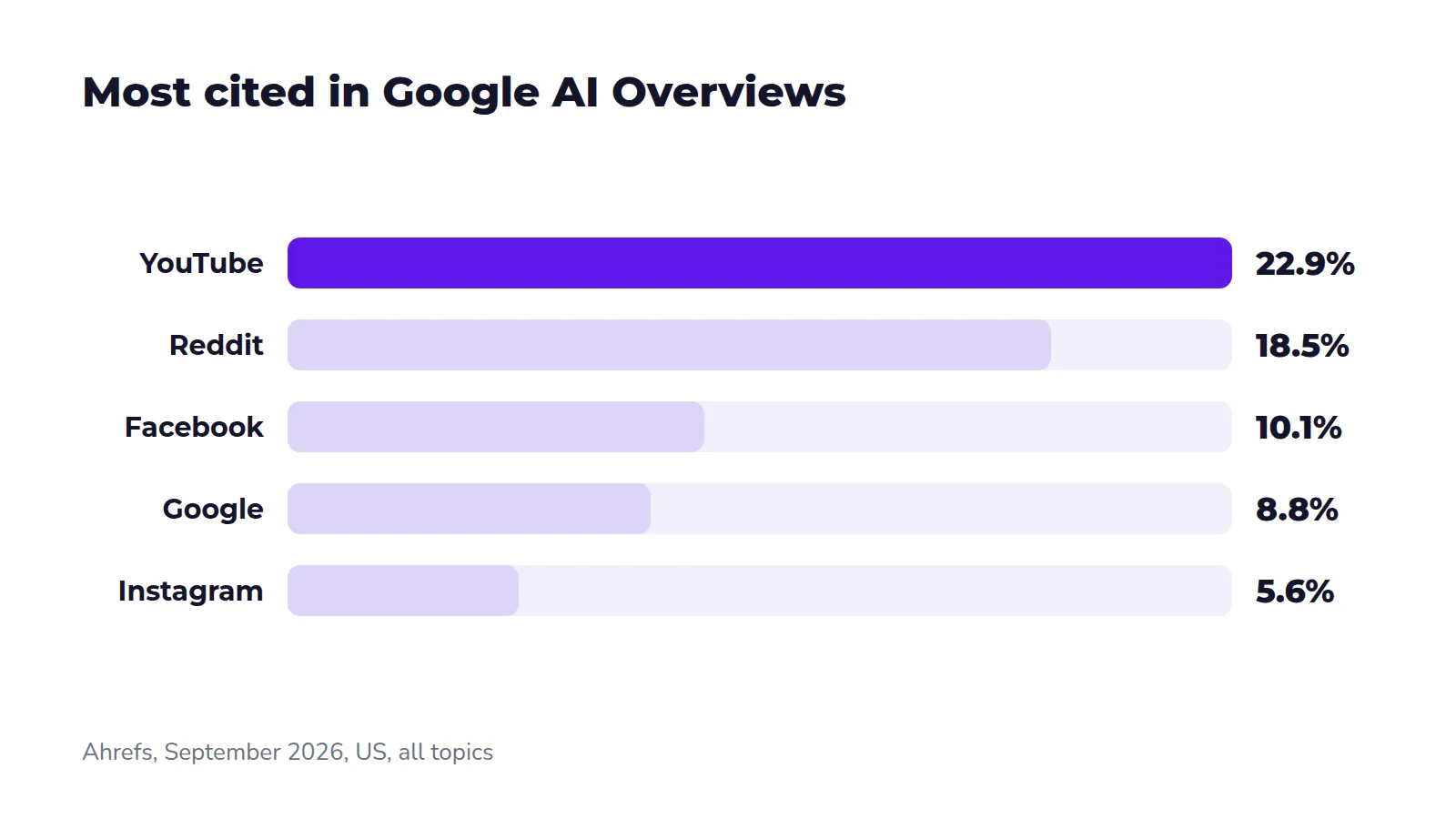
According to Ahrefs, September 2026, the website Google cites most often in its AI Overviews answers is YouTube. Mention share — 22.9%. Next: Reddit — 18.5%. Facebook — 10.1%. The sample is over three million US queries, all topics.
One clarification, so there's no confusion: 22.9% is the share of mentions among the 50 most-cited domains. Not a percentage of all searches, and not a share of YouTube users. But the order is the same: in Google's answers, video is source #1.
Why? I'll tell you as a practitioner. You write your own website yourself. Whatever you want — that's what you write. Nobody checks it.
Video lives on someone else's platform. On huge YouTube. There is a live person there. You can see how they work. You can see they're a professional. People believe that. And so does the machine.
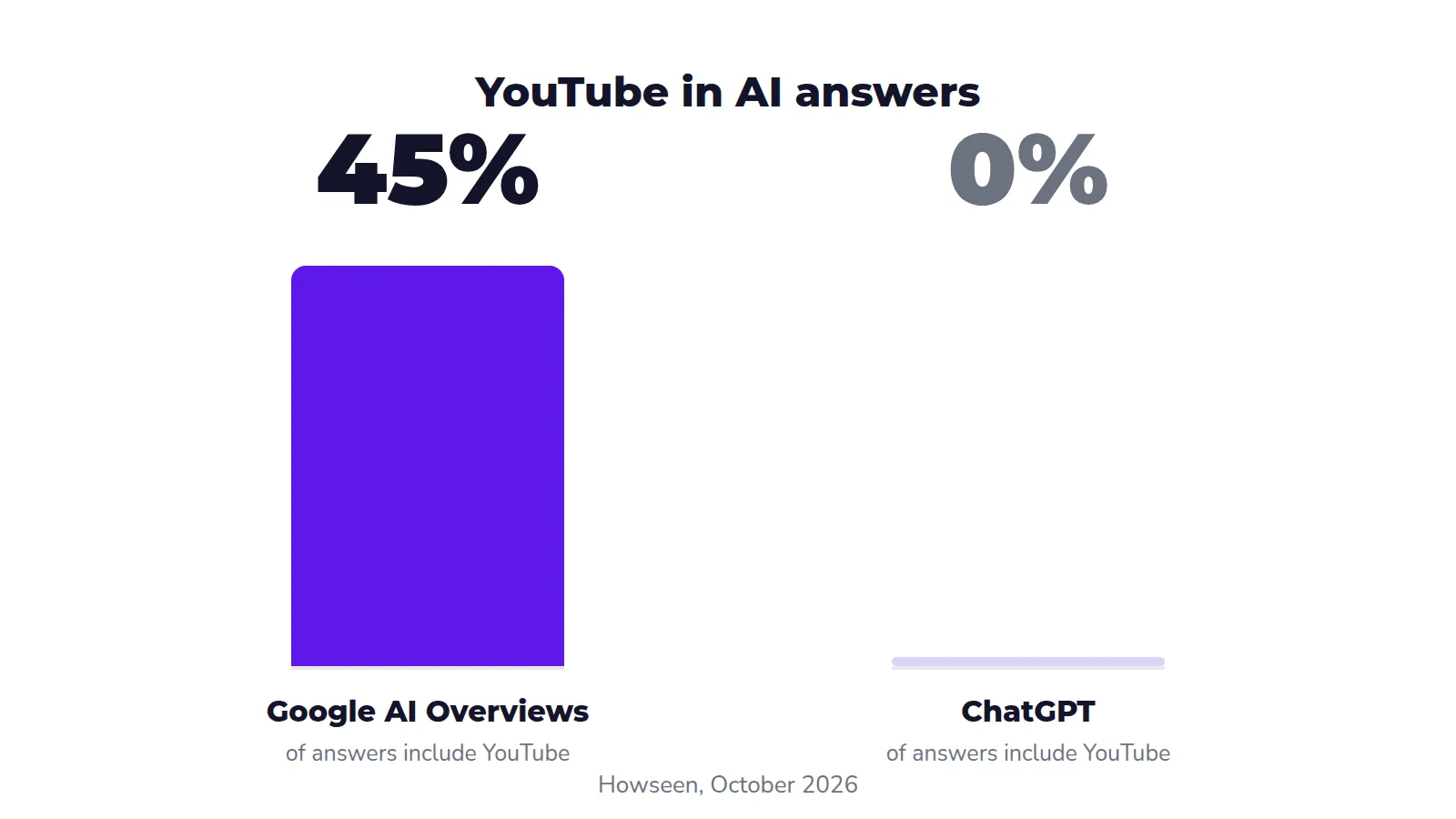
And here is an important nuance. The engines are different. The same YouTube appears in 45% of Google AI Overviews answers. According to Howseen, October 2026. A broad sample of shopping questions, not only contractors. And in ChatGPT — 0%. Zero.
So "AI loves video" is a half-truth. Google loves video. ChatGPT — almost not at all. You have to work with both surfaces. But start with the one where you can be seen.
What happens after the AI answer?
AI gave the person three names. Then the person chooses on their own. And they choose the one who feels more familiar. And more reliable.
Where do they go to check? According to Similarweb, May 2025, YouTube got 37.9 million visits from AI chatbots. That's more than Facebook, Wikipedia, and Reddit combined. Together they had 30.6 million.
The person wants to see you. Hear your voice. Understand how you think. And whether you'll rip them off for a big sum.
And here's what I notice working with clients. A call after a video is a different call. The person is already half yours. They haggle less. They compare less.
But there is a nuance that breaks the simple logic "link in the chat = click". According to a Similarweb panel study, July–December 2025, US desktop: among visits influenced by an AI recommendation, only 8.8% came through a direct AI referral. And 55.9% came through search, usually a brand query typed later.
So most people who were given a company name by the chatbot don't click the link in the chat. They later Google the company name themselves. That's why your name has to stick in memory, and your Google Maps profile has to sell the call.
And one more number about video. According to the BrightLocal 2025 survey, more than three quarters of US consumers watch video content when researching a local business. The most popular format is video the business itself publishes about its products and services: more than a third of consumers prefer exactly that.
What videos bring the customer to you specifically?
Two types. And both come from your phone. From your real conversations.
The first type is answers to the questions you get every day. One question — one video.
The main question is price. I know what you'll say: competitors will see my prices. But a competitor can call you right now and ask the price. You're hiding the price only from the customer.
And if there is no exact price, say what it depends on. What makes an AC install more expensive. What makes it cheaper. That's exactly how AI answers "how much does it cost". Through "it depends". And your video becomes the source of the answer.
More topics — from the same phone. Repair or replace. How long the job takes. How to prepare for the technician's visit. What questions to ask a technician. And what the red flags are.
Yes, you yourself give the customer the questions they will use to check you. That is trust.
The second type is narrow specialization. Not "I do everything". But specifically: who you are, for whom, where.
A plumbing tech shoots one video. About one job. Replacing one part. And that video is the single right narrow answer to a specific question the customer will ask tomorrow.
Or an auto shop. One video: how to check a car before buying it.
When you're for everyone and everywhere, AI has nothing to grab onto. When you have a narrow niche and a service area right in the language, there is something to choose you for.
What to do with the website and the ads?
Now — about money. Because that's where everything is decided.
I open an ad account. And I see: clicks are there. Impressions are there. The bill grows. And calls are fewer than last year.
The first thing I check is where the ad leads. Because most often it leads to the homepage of a heavy website. Thirty pages. Where you have to hunt for the call button.
You pay per click. The click didn't become a call. The money is gone. That is the budget leak. The problem isn't the ads. It's where they lead.
The second thing I check is whether YOU are on the page. A live person. Because the person who came from an ad is afraid to call a stranger. Put your video on the page. One minute. Where you explain the price. The person sees you. And calling gets easier.
Third — a landing page for each service. One service — one page. Not a thirty-page website. One thought-through page. With a call button. With a request form. With a time slot choice.
And fourth — what I do with client budgets every day. I don't look at clicks. I look at calls. How much one call costs. Where it came from. And what happened to it next.
And now honestly about timelines. YouTube doesn't work tomorrow. Live customers from search will come in a few months. So video doesn't replace ads.
Video builds trust. And it gets into AI answers. Google Ads and your Google Maps profile bring calls right now. Those are two different speeds. And you need both.
The mechanism is simple. Video will make you visible in AI answers. Ads will measure where the calls really come from. And you will report to yourself honestly: what worked and what didn't. And move the budget to where the calls are.
How to check yourself in 2 minutes
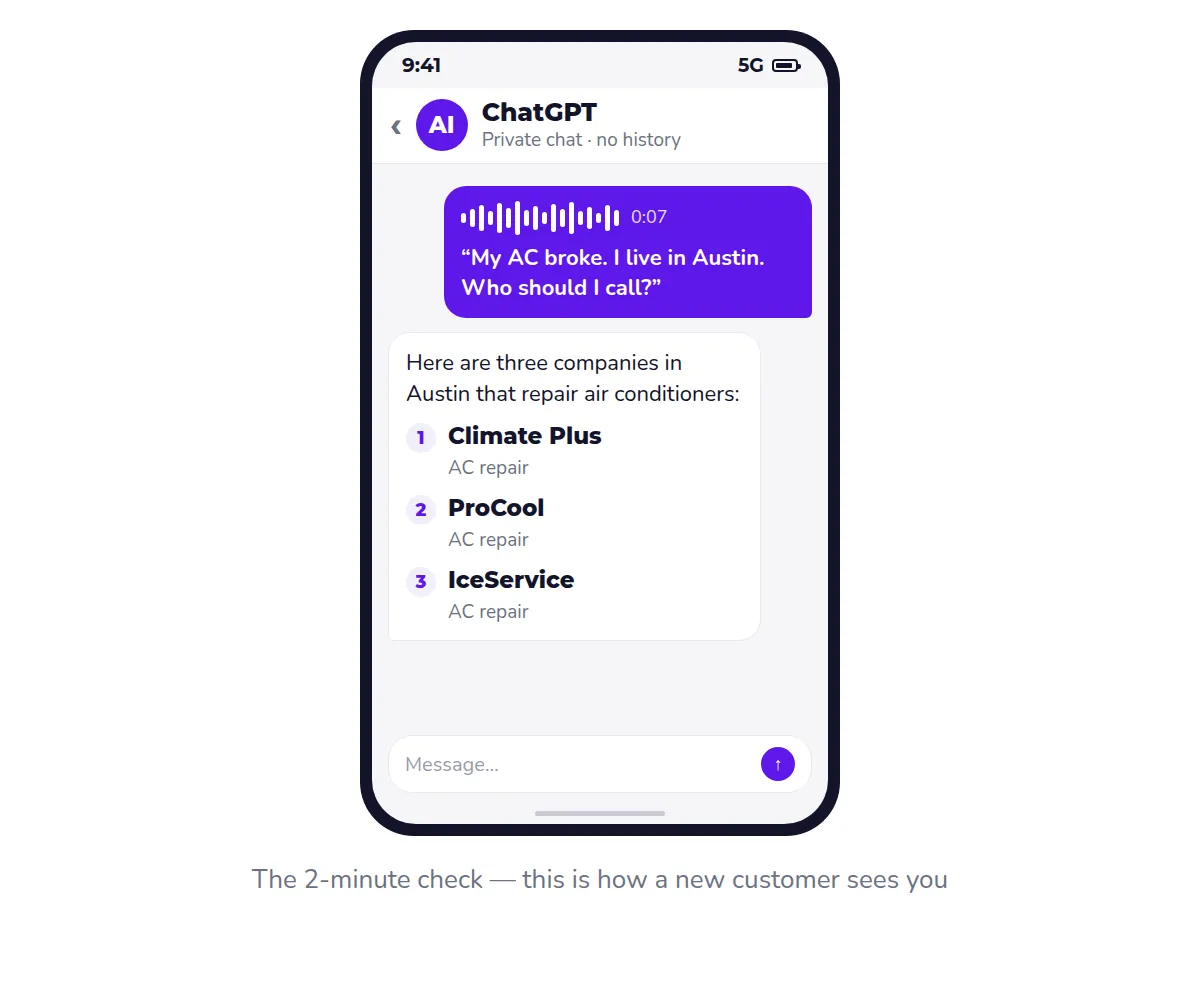
Take your phone right now. Open ChatGPT, Perplexity, or Gemini. And first — turn on a private chat. Incognito mode. So the chat has no history. Otherwise the AI remembers what you already searched. And it will show you not what a new customer sees, but what it knows about you.
And ask by voice the way your customer would ask.
For example: "My AC broke. I live in Austin. Who should I call?" Substitute your service and your city.
Check whether you're in that answer. Then ask the chat: "Why do you recommend these contractors specifically?" The AI itself will say where it got the information. Reviews. Videos. Google profiles.
That's a ready list of what you're missing, if you're not there. If you're not there right now, it means your customer went to a competitor.
When is this not for you?
Honestly about the limits. This logic isn't the same for everyone.
If you need calls tomorrow — video won't deliver them tomorrow. Start with ads and your Google Maps profile. Video is work for months, not for tomorrow.
If you have zero reviews and an empty Google profile, AI has nothing to cite. The work starts with the basics: reviews, profile, photos. And the time to the first answers will be longer.
If you build visibility on YouTube alone, you'll miss ChatGPT. YouTube is barely cited there. You need reviews, directories, and a profile too. One channel doesn't cover all surfaces.
What to do next?
Do the two-minute check today. And see whether you're in the answer.
If you're not there, that's a visibility task, and it can be solved systematically. I built an audit that gives you exact numbers: how often AI recommends your business specifically — and who it names instead of you.
And here is the video on this topic, where I show it all frame by frame:
FAQ
Why isn't my business in ChatGPT's answer? ChatGPT barely cites YouTube: in the Howseen sample from October 2026 — 0% of answers. Google AI Overviews cites YouTube in 45% of answers. One channel doesn't cover all surfaces: you need video, reviews, and a Google profile.
Where does AI get its answers about businesses? From citations. In Google AI Overviews the #1 domain is YouTube: 22.9% mention share (Ahrefs, September 2026, US). In ChatGPT the picture is different: Reddit leads at 16.8%, and YouTube is only eighth at 2.5%. Reviews and the Google Business Profile also carry weight — that is what the customer checks after the answer.
Is YouTube really the #1 source in AI Overviews? Yes. According to Ahrefs, September 2026 (US, all topics, Brand Radar, 3M+ queries), YouTube is the most-cited domain in Google AI Overviews at 22.9% mention share. Next are Reddit at 18.5% and Facebook at 10.1%.
Why does ChatGPT barely cite YouTube? The engines cite a different internet. According to Howseen (October 2026), YouTube appeared in 45% of Google AI Overviews answers but in 0 of 1,164 ChatGPT answers. According to Ahrefs (September 2026), in ChatGPT YouTube ranks eighth by mention share (2.5%), while Reddit leads at 16.8%. Betting on video alone, without text sources, does not work in ChatGPT.
Do people click through from chatbots to a business website? Rarely directly. According to a Similarweb panel study (July–December 2025, US desktop), only 8.8% of visits influenced by an AI recommendation came through a direct click from the chat, while 55.9% came through a search for the company name later. That is why the name has to be memorable and the Google Maps profile has to sell the call.
Does this mean SEO no longer works? No. But the click in the old search results is shrinking: according to Pew, users who saw an AI summary clicked an ordinary result in 8% of visits versus 15% without a summary. The fight is for a place inside the AI answer.
How long does it take to appear in AI answers? Months, not days. Video doesn't work tomorrow. Live customers from search will come in a few months. That's why video doesn't replace ads: Google Ads and your Google Maps profile bring calls right now.
Is one video enough? No. You need a system: answers to customer questions, narrow specialization, reviews, a complete Google Maps profile. One video is one signal; AI chooses based on the combination.
How do I check whether AI sees me? Open ChatGPT, Perplexity, or Gemini in a private chat with no history, and ask by voice the way your customer would. Then ask: 'Why do you recommend these contractors specifically?' — the AI itself will say where it got the information.
What does an AI-visibility audit give you? Exact numbers: how often AI recommends your business specifically — and who it names instead of you. That's the basis for understanding exactly what you're missing.
Sources
- Ahrefs — The 50 Most-Cited Websites in Google AI Overviews (September 2026)
- Howseen — Google's AI Cites YouTube in 45% of Answers. ChatGPT Never Does. (2026 Data)
- Similarweb — The Top 50 Sites Getting Traffic from AI Chatbots
- PPC Land — Explaining AI referral traffic
- Pew Research Center — Google users are less likely to click on links when an AI summary appears
- BrightLocal — Local Consumer Review Survey 2025
I have been building websites and advertising since 2009, and for the last 3 years — artificial intelligence. I build full multi-agent systems that replace entire departments for businesses and experts. If AI names someone else for your service, that is a visibility task — and it can be solved systematically.
*By Ievgen Kovalevskyi, AI automation architect.*